
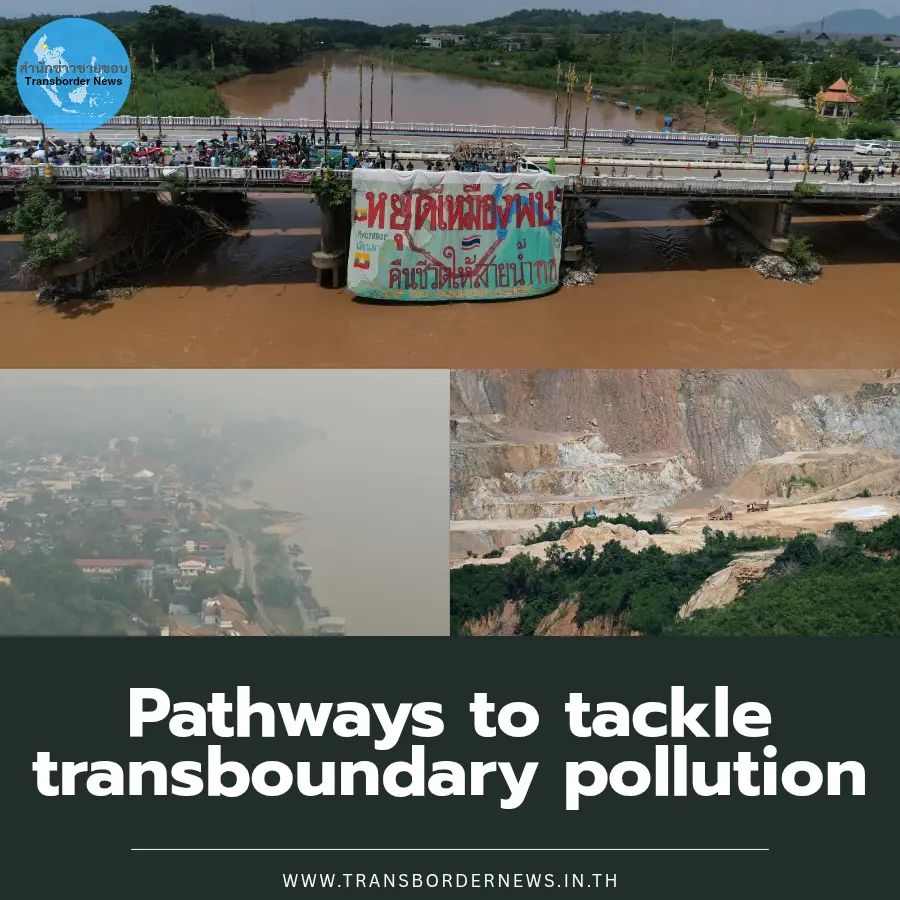
CHIANG MAI/CHIANG RAI: Thailand’s representative to the ASEAN Intergovernmental Commission on Human Rights has called for the use of the ASEAN declaration on environmental rights to address worsening transboundary pollution, as a former Mae Sai mayor warned that powerful corporate interests are hindering effective action.
Assoc Prof Dr Bhanubhat Jittiang, Thailand’s representative to AICHR for the 2025–2027 term, said he had recently returned from Chiang Mai, where he experienced severe haze and pollution firsthand.
“Within three days, I felt dizziness and skin irritation. It raises serious concerns about the health and daily lives of people living in Chiang Mai and across the North,” he said on April 6.
He described the region’s haze, transboundary air pollution and toxic contamination in rivers as a growing public health, governance and human rights challenge. The situation, he said, is compounded by multiple factors, including forest fires, agricultural burning, cross-border haze, toxic runoff from upstream mining, ongoing conflict in Myanmar, fragmented state authority in border areas, and geopolitical competition over rare earth minerals and other strategic resources.
In this context, Dr Bhanubhat highlighted the importance of the ASEAN Declaration on the Right to a Safe, Clean, Healthy and Sustainable Environment, which was adopted by ASEAN leaders in October 2025. The declaration builds on earlier efforts led by Prof Emeritus Dr Amara Pongsapich, a former Thai representative to AICHR.
He said the declaration provides a crucial policy framework by recognising environmental rights as human rights, while affirming commitments to prevent, control and mitigate environmental degradation. It also promotes access to information, meaningful public participation, access to justice, and stronger scientific and technical cooperation. Importantly, it underscores that private sector actors also have a responsibility to respect environmental rights.
Dr Bhanubhat urged the Thai government to take concrete steps, including accelerating a national action plan to implement the declaration, improving transparency and public access to environmental data, addressing domestic drivers of environmental degradation, and using the framework to strengthen regional accountability on transboundary issues.
He also stressed that environmental governance in border areas cannot be separated from conflict and geopolitics. In areas affected by armed conflict, weak governance and entrenched transnational crime — particularly along the Thai-Myanmar border — environmental damage is more difficult to address and often neglected.
Meanwhile, Chaiyon Srisamut, former mayor of Mae Sai municipality in Chiang Rai, said PM2.5 pollution in Mae Sai remains among the highest in the country, worsened this year by prolonged El Niño conditions that have reduced rainfall.
“Thailand is effectively waiting for rain to solve PM2.5, as successive governments have limited capacity to act, given that most sources are outside the country,” he said.
He added that any solution must involve three parties: affected communities, the government, and beneficiaries — namely companies promoting corn cultivation and imports. However, discussions have largely excluded these corporate actors.
Recent measures by the Commerce Ministry requiring import certification for maize have limited impact, he said, as there is no reliable way to verify whether burning practices have actually ceased in source countries.
Mr Chaiyon explained that Mae Sai’s geography — a basin surrounded by mountains — traps polluted air, while seasonal wind patterns bring smoke from Myanmar and northern Thailand, compounding the impact even when there is no local burning.
He said he had called since 2023 for the area to be declared a disaster zone, but authorities declined, citing concerns over tourism. “In reality, when PM2.5 levels reached 800–900, tourists had already stopped coming. The reluctance to declare a disaster may reflect hidden political factors. If this continues, the situation will become untenable,” he said.
Asked about proposals to the government, Mr Chaiyon said businesses must adjust their operations to give local communities confidence that conditions will improve. If the government cannot resolve the issue, he suggested closing border checkpoints to halt maize imports, creating pressure for more serious negotiations.
“Only a few large companies are involved, and they are closely linked to successive governments. That makes it difficult to push through meaningful measures,” he said.
This is a translation of original Thai article https://transbordernews.in.th/home/?p=45646