
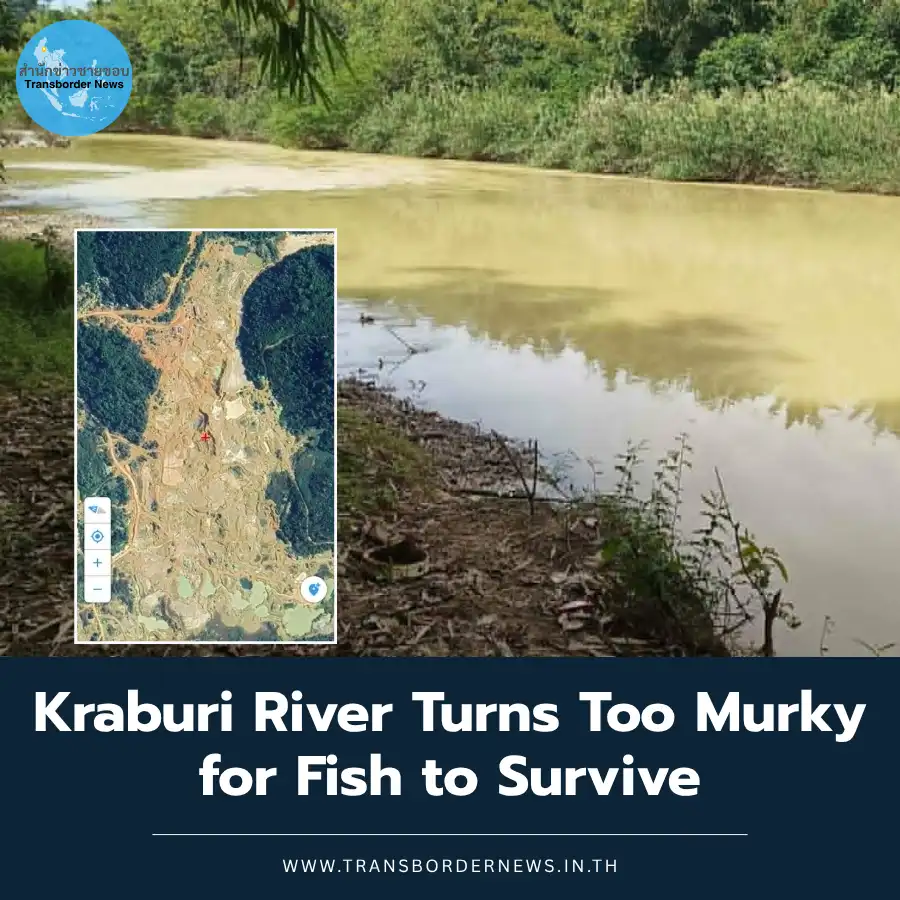
RANONG, 14 May 2026 — Communities along the Kraburi River are facing growing hardship as severe sediment pollution linked to upstream mining activities in Myanmar continues to worsen, local officials and residents say.
Wirasing Kotsasing, chief of Pak Chan tambon administration organisation in Kraburi district, said a public forum titled “Opening Space, Reflecting the Voices of Ranong People” will be held on May 19 in Ban Hat Chik village in cooperation with the Office of Environment and Pollution Control Region 15 in Phuket.
The event will allow affected villagers to voice concerns over persistent murky water in the Kraburi River, which residents believe is caused by mining operations near the river’s headwaters across the border in Myanmar. Officials from the pollution control office are expected to explain recent water quality monitoring results.
Mr Wirasing said the river remains heavily polluted, with muddy water flowing around the clock and no clear-water periods remaining.
The river is also used as a raw water source for local tap water production, affecting water quality supplied to households. Residents have also noticed declining fish populations, as fish can no longer survive in the heavily turbid water and have migrated elsewhere.
Villagers are now reluctant to use river water for livestock, fearing possible contamination, while concerns continue growing over long-term health impacts despite recent official tests finding no toxic substances exceeding safety standards.
“People are very worried. Every morning, this issue is discussed in local coffee gatherings,” Mr Wirasing said. “People are afraid to eat fish because they fear toxic contamination. Elderly residents say they have never seen the river this bad and believe it may never become clear again.”
He said local authorities have spent years trying to address the problem through coordination with district and provincial agencies, but conditions have only deteriorated over the past seven years.
Satellite imagery shows mining activities upstream in Myanmar have expanded rapidly across thousands of rai in all directions, with little visible regulation, he said.
According to provincial information, minerals extracted in Myanmar are transported through Kawthaung before being declared at Ranong port and exported onward to third countries. While most are identified as tin ore, concerns remain over whether other minerals are also being transported.
Mr Wirasing called on the Thai government to urgently address the issue and tighten scrutiny over imported minerals.
“Even if Thailand cannot stop mining activities in another country, imported minerals should at least have clear traceability and come from mines that meet proper standards,” he said.
Peera Prasongwet, coordinator of the Kraburi River Conservation Network, said communities remain deeply concerned about household water safety and the long-term ecological consequences.
Although heavy metal contamination has not yet exceeded official standards, he said the continuous murky conditions have already disrupted fisheries, livestock raising, agriculture and other river-based livelihoods.
“If the river remains muddy throughout the year and communities can no longer continue their way of life, how will the government compensate affected people?” he asked.
Residents are also increasingly concerned about possible health risks, including skin diseases linked to long-term exposure to polluted water.
Mr Peera urged authorities to establish stronger monitoring, warning systems and clear public guidelines, while also calling for continuous water quality testing and the creation of multi-level task forces to address the crisis.
He said the Thai government must coordinate with Myanmar authorities and armed groups controlling the area to pressure mining operators to comply with environmental standards.