
CHIANG RAI, June 5, 2026 — Community groups representing six river basins affected by toxic contamination submitted a seven-point proposal to the Thai government on World Environment Day, calling for urgent action to address transboundary pollution linked to mining activities in neighbouring countries.
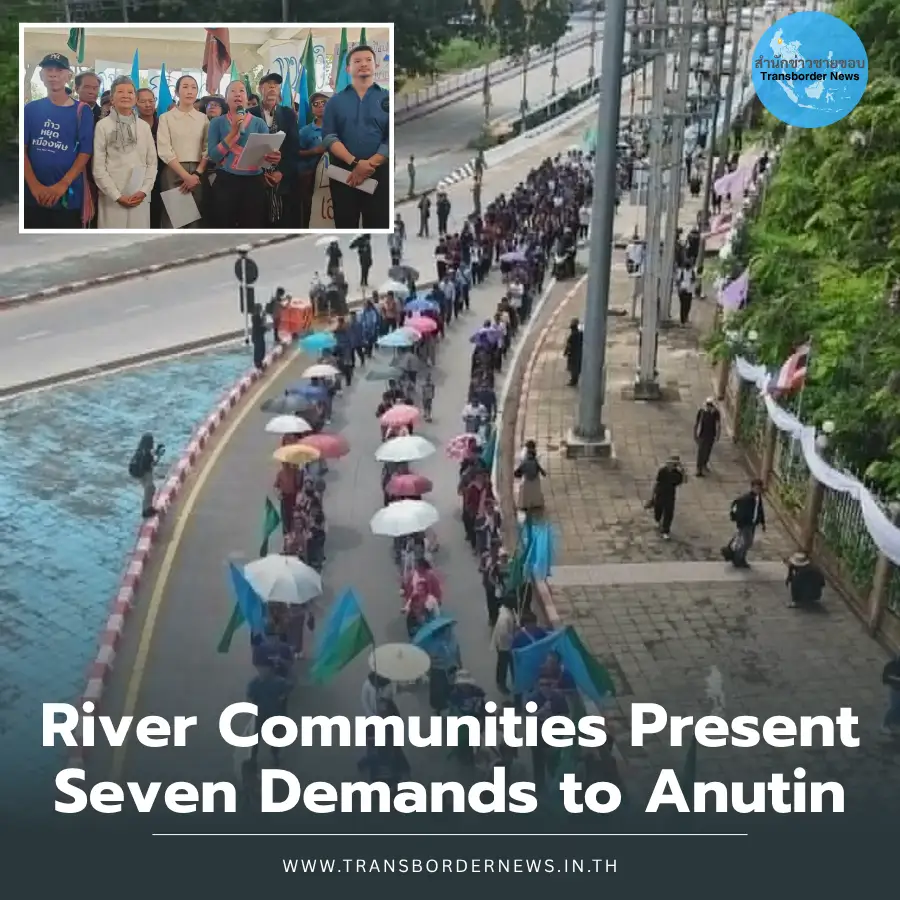
The appeal came as hundreds of monks, novices and residents participating in the Peace Walk for Rivers arrived in Chiang Rai after completing a six-day march from Tha Ton in Chiang Mai province. Organised by the People’s Network to Protect the Kok, Sai, Ruak, Mekong, Salween and Kraburi rivers, the event culminated in a public gathering at Mae Fah Luang Park before participants marched to Chiang Rai Provincial Hall.
The atmosphere was lively, with participants carrying banners calling for the restoration of contaminated rivers and stronger government action. A procession organised by Chiang Rai artists depicting the impacts of contamination on different river systems attracted particular attention.
Niwat Roykaew, chairman of the Chiang Khong Conservation Group, said the event marked one year since communities first began campaigning over river contamination.
“For the past year we have demanded action at the source of the problem, yet successive governments have failed to respond with concrete measures,” he told participants. “Today we are asking what the government has actually done. The contamination crisis has not improved. It is becoming more severe.”
Mr Niwat said communities living along the rivers remain heavily dependent on river-based food sources despite knowing the waterways are contaminated.
“What is most heartbreaking is that people cannot walk away from the rivers that sustain them,” he said. “If this crisis is not addressed seriously, it will not only destroy local economies but also erase the river cultures that have existed since the time of King Mangrai. The abundance that has sustained generations is being destroyed.”
He expressed disappointment that senior government leaders did not attend the event.
“We hoped the Prime Minister would come and hear directly from affected communities. We then hoped that at least a senior minister would attend. Now we have learned that even junior ministers may not come. It is deeply discouraging and suggests that the suffering of local people is not being taken seriously.”
“Whether government leaders come or not, we will continue this struggle to protect the lives of our children and future generations,” he said.
Katsama Ayi, secretary-general of the Khon Khon Foundation for Change, said contamination in the Kok River was not an issue affecting only a single community but one with consequences for people throughout Chiang Rai and Chiang Mai provinces.
“The government must urgently coordinate efforts to stop mining activities, which are the root cause of the problem,” she said. “This issue deserves immediate national attention.”
Watchadaporn Pornsakulwiwat, an ethnic student from Sahasart Suksa School, said she joined the event to learn more about the environmental crisis and its impacts on people’s lives.
After the march reached Chiang Rai Provincial Hall, monks and novices chanted blessings to mark the conclusion of the Peace Walk. Representatives of the network then read a statement addressed to Prime Minister Anutin Charnvirakul, calling on the government to elevate transboundary pollution to a national agenda item and expressing disappointment at what they described as official inaction.
The statement noted that the government’s policy declaration on April 9 had pledged to strengthen border security, address cross-border challenges with neighbouring countries and prevent environmental threats, including illegal mining.
The network’s seven demands include:
1 Establish a national policy and high-level task force to address transboundary contamination affecting the Kok, Sai, Ruak, Mekong, Salween, Kraburi and other international rivers.
2 Pursue urgent diplomatic engagement with Myanmar, China and regional bodies to investigate pollution sources, control contamination and restore affected areas.
3 Implement a minimum five-year national monitoring programme covering water quality, sediments, aquatic life, food chains and public health impacts, with transparent public reporting.
4 Introduce controls on mineral imports linked to environmentally harmful mining operations and require transparent supply-chain traceability.
5 Regulate exports of machinery, equipment and business services from Thailand that may support mining activities causing transboundary impacts.
6 Develop permanent legal and institutional mechanisms to prevent and respond to transboundary pollution, including monitoring, early warning systems, public disclosure, remediation and application of the polluter-pays principle.
7 Visit affected communities in person and listen directly to residents to demonstrate that the government has not abandoned them.
Earlier in the day, Asst Prof Wan Wiriya of Chiang Mai University’s Environmental Science Research Centre collected water samples from the Kok River near Mae Fah Luang Bridge using a field testing kit. Preliminary results indicated arsenic concentrations several times above the accepted standard, drawing significant attention from journalists covering the event.