
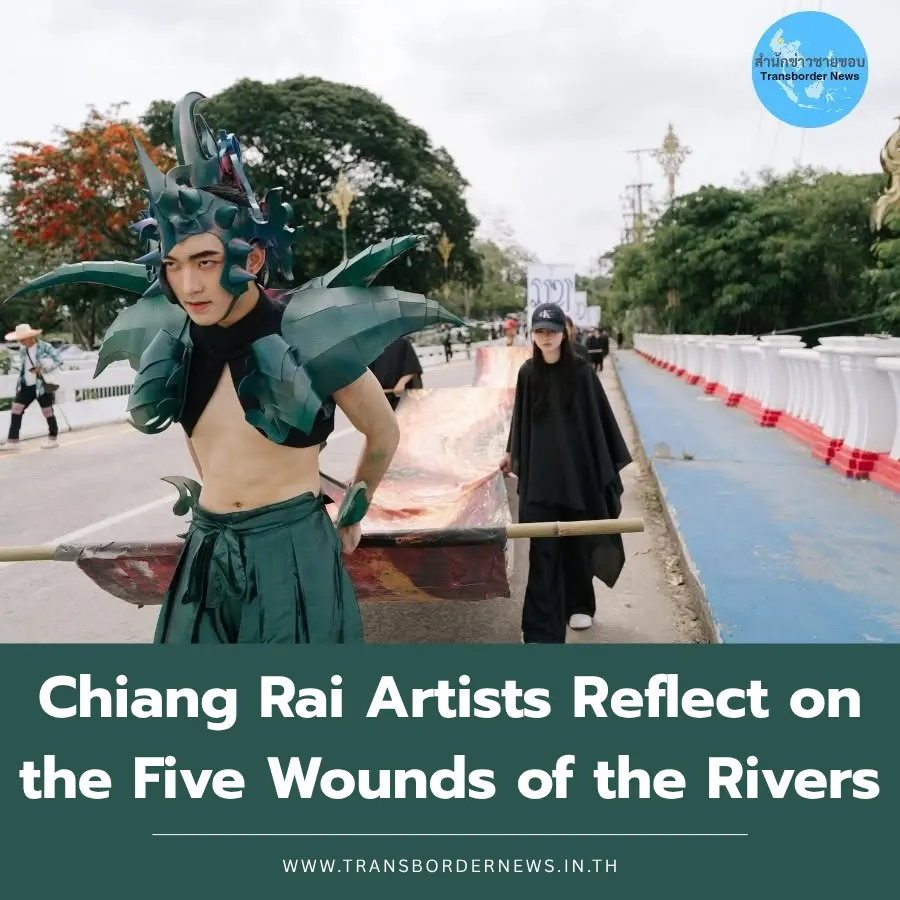
CHIANG RAI, Thailand, June 5, 2026 — As participants in the Peace Walk for Rivers marched from Mae Fah Luang Public Park to Chiang Rai Provincial Hall on World Environment Day, the attention of onlookers and journalists was drawn to a striking artistic procession titled “Five Rivers, Five Wounds.”
Created by artists from the Chiang Rai Art Bridge Association (Khua Silapa), the performance combined visual art, music and symbolic theatre to portray the growing crisis of toxic contamination affecting some of mainland Southeast Asia’s most important rivers. Through paintings, poetry, song and live performance, the artists sought to communicate the environmental and human costs of pollution threatening the Kok, Sai, Ruak, Mekong and Salween rivers.
Dressed in black to symbolize loss and mourning, more than 50 artists joined the march carrying paintings and performing alongside the procession. Repeated chants and songs invoking the names of the five rivers — “Kok, Sai, Ruak, Mekong, Salween” — echoed through the streets, urging the public to recognize the urgency of protecting waterways that sustain millions of people.
One participating artist explained that each river was represented through a distinct artistic concept reflecting its unique circumstances.
“The Kok River is portrayed as the river of bloodlines, representing the deep bond between the river and the people of Chiang Rai. The Sai River is the river of silence, depicted through sepia tones that convey grief and neglect. The Ruak River is the border of pain, reflecting its position along the Thai-Myanmar frontier and the suffering experienced there. The Mekong is portrayed as the mother of life struggling to breathe, symbolizing the region’s main artery now facing serious contamination. The Salween is represented as nature’s final voice, expressing the destruction of once-abundant ecosystems,” the artist said.
According to organizers, the artworks were funded through contributions from artists and partner organizations. The Chiang Rai Art Bridge Association served as a platform for collaboration between artists and environmental networks, helping transform public concerns into creative expression.
National Artist and senior association member Somlak Pantiboon said artists could not remain indifferent when the environment that inspires their work comes under threat.
“Artists depend on the environment and local culture as the raw materials of creativity. When the environment dies, art is inevitably affected. Artists are ordinary citizens who live in the city, breathe the same air and share the same resources as everyone else. We therefore have a responsibility to stand up and defend the environment,” he said.
He added that the symbolic artworks presented during the procession reflected the suffering of rivers while maintaining the aesthetic qualities that define artistic expression.
“Even when addressing painful realities, artists communicate through beauty. Each artist tells the story in their own way,” he said.
Veteran artist Sompong Sarnsap said Chiang Rai’s artistic community has long maintained a strong attachment to its natural surroundings.
“Most Chiang Rai artists were born here. Even when they leave to study or work elsewhere, many eventually return. The natural environment is the source of their inspiration. When our home faces environmental problems, artists feel a responsibility to respond and contribute to solutions,” he said.
He compared artists’ dependence on nature to fish depending on water.
“If natural resources disappear, the aesthetic foundation of art disappears with them,” he said.
Mr Sompong also reflected on the growth of Chiang Rai’s artistic movement, which began formally in the early 1990s under the leadership of renowned artists Thawan Duchanee and Chalermchai Kositpipat. What began as a small collective known as “Nine Chiang Rai Artists” has evolved into the Chiang Rai Art Bridge Association, now bringing together hundreds of artists with a shared vision of establishing Chiang Rai as a true city of art and artists.
Poet and artist Sansoen Duangdee, who composed verses for the procession, said art has become a vital tool for environmental advocacy.
“Art captures attention and encourages participation. Poetry, music, painting and performance can communicate issues in ways that statistics and reports cannot. Today, artists and activists increasingly work together toward a common goal — protecting our rivers,” he said.
He emphasized that the artists’ network believes those responsible for environmental damage should be held accountable.
“Environmental problems require systematic solutions. Those who profit from pollution must take responsibility for the damage they cause. The solidarity between artists and community networks is an important force in demanding environmental justice,” he said.
For organizers, “Five Rivers, Five Wounds” was more than an art exhibition. It transformed the experiences, fears and hopes of local communities into tangible forms that could be seen, heard and felt. Through paintings, music, poetry and performance, the artists amplified the message of a growing environmental movement.
Although the five rivers differ in geography and history, the artists argued that they now share the same wound — environmental destruction driven by extractive industries and compounded by political systems that have failed to respond quickly enough.
The performance ultimately served as a warning: if society continues to ignore the crisis, today’s wounds may become permanent scars that can no longer be healed.