
By Moe Satt Min Khant
Introduction
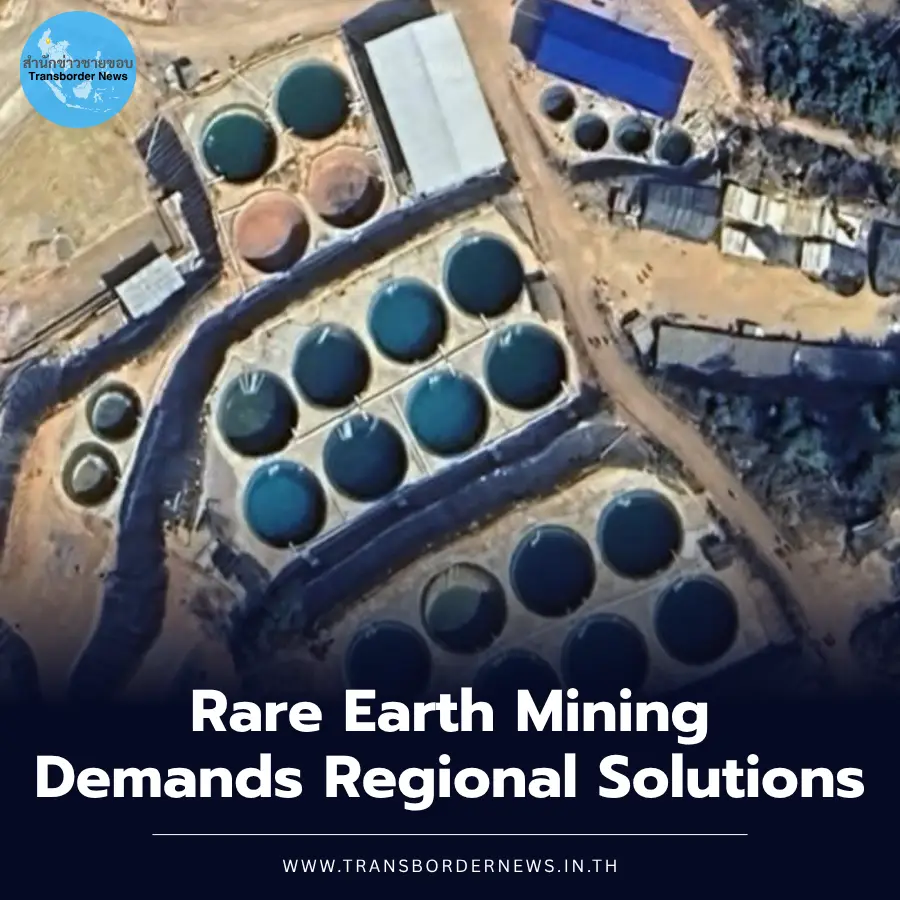
The rapid expansion of rare earth mining in Myanmar’s eastern borderlands has emerged as one of Southeast Asia’s most pressing environmental and governance challenges. While public attention has focused on arsenic and heavy metal contamination in the Kok, Sai, and Ruak Rivers affecting communities in northern Thailand, the issue extends far beyond transboundary pollution. It highlights the complex interaction between armed conflict, non-state actors, foreign investment, and global supply chains.
Myanmar possesses significant deposits of rare earth elements (REEs), which are essential for modern technologies including electric vehicles, wind turbines, smartphones, and advanced defense systems. As global demand for critical minerals increases, mining activities have expanded into conflict-affected regions where governance is fragmented and state oversight remains weak. In many of these areas, non-state armed actors exercise de facto control over territory and natural resources, creating conditions that enable large-scale extraction with limited environmental regulation.
The challenge is therefore not merely a domestic issue for Myanmar. It is a regional environmental security concern involving Myanmar, Thailand, and China, requiring coordinated responses that address both resource governance and accountability throughout the supply chain.
Rare Earth Mining and the Role of Non-State Actors
Myanmar’s political and security landscape has undergone significant transformation since the 2021 military coup. In many border regions, particularly in Kachin and Shan States, territorial control is divided among the military, ethnic armed organizations (EAOs), border guard forces, militias, and other non-state actors.
This fragmented governance environment has created opportunities for resource extraction activities beyond effective state regulation. Rare earth mining projects often operate in territories where administrative authority is contested or controlled by non-state actors rather than the central government. Revenues generated from mining can become an important source of income for local authorities, armed groups, and associated business networks.
The involvement of non-state actors does not necessarily mean they are the sole operators of mining projects. Rather, they frequently serve as gatekeepers who control access to land, provide security, negotiate permits, collect taxes, or facilitate investment arrangements. As a result, rare earth mining in Myanmar frequently exists within a complex political economy involving local power holders, foreign investors, traders, and transnational supply chains.
Such arrangements complicate accountability. When environmental damage occurs, responsibility becomes difficult to determine because multiple actors participate in different stages of extraction, transportation, processing, and export.
Chinese Investment and Supply Chain Connectivity
China remains the dominant actor in the global rare earth industry, accounting for the majority of global processing and refining capacity. Consequently, rare earth extraction in Myanmar is closely connected to Chinese markets, technology, investment networks, and industrial demand.
Numerous reports and policy analyses have suggested that rare earth ores extracted from Myanmar are transported into China for processing and integration into global manufacturing supply chains. This relationship has generated increasing scrutiny regarding the role of Chinese companies and investors operating directly or indirectly in Myanmar’s mining sector.
Recent legal developments in China are therefore particularly significant. The Rare Earth Management Regulations (2024), export control measures governing rare earth technologies, and the Overseas Investment Regulations scheduled to enter into force in July 2026 collectively establish a stronger framework for regulating Chinese actors operating abroad.
These regulations emphasize environmental responsibility, legal compliance, technology transfer controls, and oversight of overseas investments. If Chinese companies are found to be contributing to environmentally harmful mining activities abroad, Chinese authorities now possess stronger legal mechanisms to investigate and potentially sanction such conduct.
The effectiveness of these measures, however, will depend on implementation. Myanmar’s rare earth sector represents an important test case for whether China’s regulatory framework can extend accountability beyond its borders and address environmental harms associated with overseas investments.
Environmental Security and Regional Consequences
The environmental consequences of unregulated mining extend across national boundaries. Communities living along the Kok, Sai, and Ruak River systems have increasingly raised concerns regarding water quality, contamination risks, and the potential impacts on agriculture, fisheries, tourism, and public health.
As discussed in the Fulcrum analysis, “Thailand Pays the Price for Unregulated Mining Boom,” environmental impacts generated in upstream mining zones can produce significant downstream consequences for neighboring countries. River systems do not recognize political boundaries, making environmental degradation a shared regional challenge rather than a purely national concern.
This reality transforms rare earth mining from a resource governance issue into an environmental security issue. Pollution, ecosystem degradation, and resource conflicts have the potential to undermine livelihoods, increase social tensions, and strain diplomatic relations among neighboring states.
The Need for Trilateral Dialogue
Addressing these challenges requires more than unilateral action. A trilateral dialogue involving China, Myanmar, and Thailand could provide an important platform for cooperation.
First, such dialogue could facilitate information sharing regarding mining activities, environmental monitoring, and pollution risks. Transparency remains one of the greatest obstacles to effective governance in conflict-affected mining regions.
Second, trilateral cooperation could support joint environmental assessments of shared river basins. Independent scientific monitoring would help establish evidence-based understandings of contamination sources and environmental impacts.
Third, China could play a constructive role by strengthening due diligence requirements for companies and investors operating in Myanmar. Enhanced supply chain transparency would improve accountability and reduce incentives for environmentally harmful practices.
Fourth, engagement with local communities and non-state actors should not be ignored. Because many mining operations occur in territories outside effective state control, sustainable solutions require dialogue with all relevant stakeholders who influence resource governance on the ground.
Conclusion
Rare earth mining in Myanmar illustrates the growing intersection between critical mineral supply chains, armed conflict, environmental governance, and regional security. The involvement of non-state actors, combined with foreign investment and weak regulatory oversight, has created significant challenges for accountability and environmental protection.
China’s evolving legal framework offers new opportunities to strengthen oversight of overseas investments and technology transfers. However, the true measure of success will be whether these regulations are effectively applied in complex contexts such as Myanmar.
Ultimately, the future of the Kok, Sai, and Ruak River basins will depend not only on domestic governance reforms but also on meaningful regional cooperation. A trilateral dialogue among China, Myanmar, and Thailand could serve as a practical mechanism for promoting transparency, environmental responsibility, and sustainable resource governance. In an era of increasing demand for critical minerals, ensuring that economic development does not come at the expense of environmental security has become a shared regional responsibility.
————–
Moe Satt Min Khant is a student at the School of Social Innovation, Mae Fah Luang University