
By Paskorn Jumlongrach
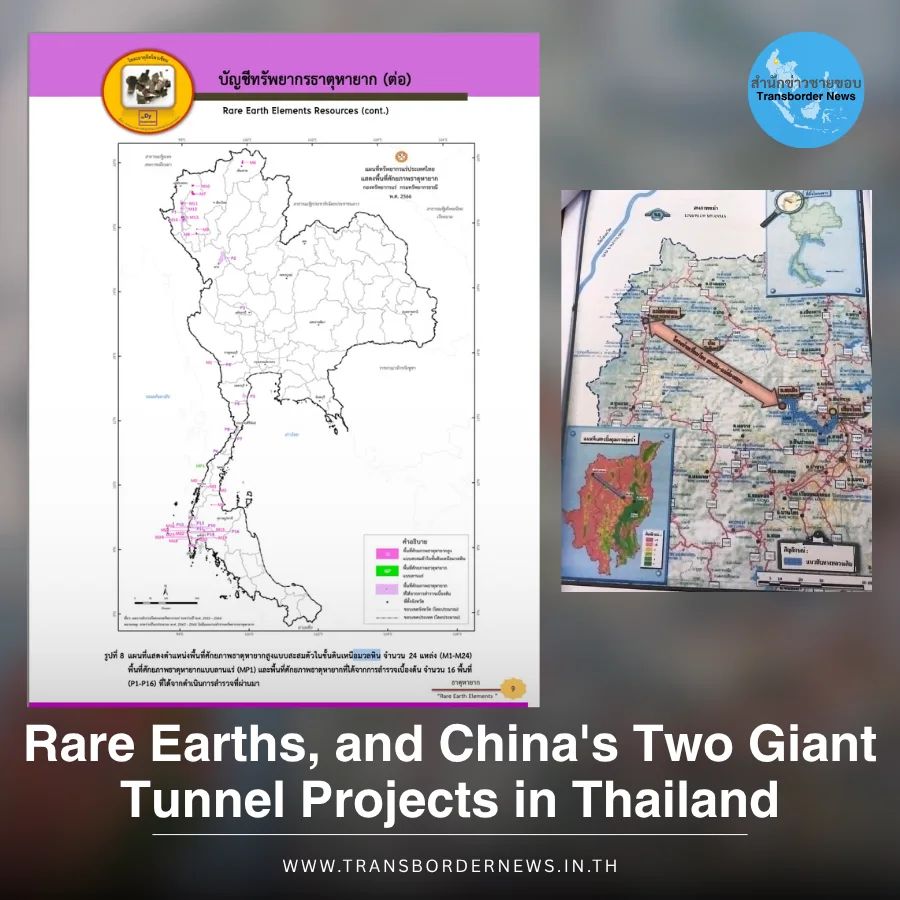
Thailand’s western mountain ranges are known for their forests, rivers, and biodiversity. Less well known is what lies beneath them.
According to the latest Mineral Resource Atlas published by Thailand’s Department of Mineral Resources, significant rare earth deposits have been identified across northern and western Thailand. Major deposits are mapped in Chiang Mai and Mae Hong Son provinces, with additional potential extending south through Tak, Kanchanaburi, and as far as Phang Nga.
The figures are striking. The Pong Khao–Wat Chan deposit in Chiang Mai alone is estimated to contain more than 1.27 million tonnes of rare earth oxides. Other sizeable deposits have been identified in Hot, Omkoi, Pai, Khun Yuam, Mae La Noi, and Mae Sariang.
Importantly, these estimates exclude protected areas such as national parks and wildlife sanctuaries that blanket much of Thailand’s western forests.
Geologists explain that the rare earth deposits stretching from southern China through Myanmar’s Shan State into northern Thailand are largely hosted in weathered granite near mountain surfaces. Unlike traditional hard-rock mining, these deposits do not necessarily require deep excavation, making them particularly attractive for modern extraction.
Whether by coincidence or design, two massive infrastructure projects are now being aggressively promoted in exactly these regions.
The first is the long-delayed Yuam River Diversion Project, officially designed to increase water supplies for the Bhumibol Dam. Originally budgeted at 70 billion baht, many observers believe the final cost could easily exceed 100 billion baht.
Its centrepiece is a 64-kilometre tunnel bored through mountains from Sop Moei District in Mae Hong Son to Hot District in Chiang Mai.
The project has long been championed by influential politicians and previously advanced through one of Thailand’s most controversial Environmental Impact Assessments—widely criticised by academics and civil society for containing serious discrepancies between documented field conditions and the report itself. The assessment nevertheless received unusually rapid approval. Community groups have since challenged the project before Thailand’s Administrative Court.
One political advocate publicly stated that Chinese state-owned enterprises had expressed interest in financing the project, suggesting Thailand would bear little financial burden.
Although the proposal had remained dormant for some time, it has recently been revived under the current government, with renewed political backing and fresh field studies aimed at pushing it forward.
The second proposal is a new Chiang Mai–Samoeng–Mae Hong Son highway involving approximately 161 kilometres of roadway and five mountain tunnels, with an estimated construction cost of around 30 billion baht.
Chinese involvement has already become visible.
In March this year, executives from China Highway Engineering Consulting Group, a major Chinese state-owned enterprise, met the governor of Mae Hong Son to discuss the project’s feasibility. Provincial authorities are now actively promoting the proposal, emphasising tourism, trade, and economic development while offering remarkably little public discussion of environmental, social, or geological risks.
The similarities between these two projects deserve closer scrutiny.
First, both tunnel routes pass directly through regions identified by Thailand’s own geological surveys as containing substantial rare earth deposits.
Second, both have attracted considerable interest from Chinese state-owned enterprises.
That matters because China dominates the global rare earth supply chain.
Although rare earth minerals are mined in several countries, China controls almost all downstream processing capacity needed to separate and refine individual rare earth elements. These materials have become indispensable for electric vehicles, wind turbines, advanced electronics, semiconductors, and military technologies. They have also become a strategic instrument in Beijing’s geopolitical competition with the United States and other major powers.
Across Myanmar’s Shan States and increasingly in Laos, Chinese-backed rare earth mining has expanded dramatically over the past several years. The environmental consequences are becoming impossible to ignore.
Communities along the Kok, Sai, Ruak, Mekong, and Salween rivers are already living with heavy metal contamination linked to upstream mining operations. Rivers that once sustained fisheries, agriculture, and local livelihoods are now the subject of growing public health concerns. Yet nearly all of the extracted minerals continue to flow into China because no other country possesses comparable large-scale processing capacity.
Thailand should pay close attention to these regional developments.
Over recent years, the country has increasingly served as a base for Chinese cr