
Activists say China’s security cannot be built on dying rivers; People’s Party shadow cabinet urges Thailand not to let China think it can “do anything” and calls for broader diplomatic engagement
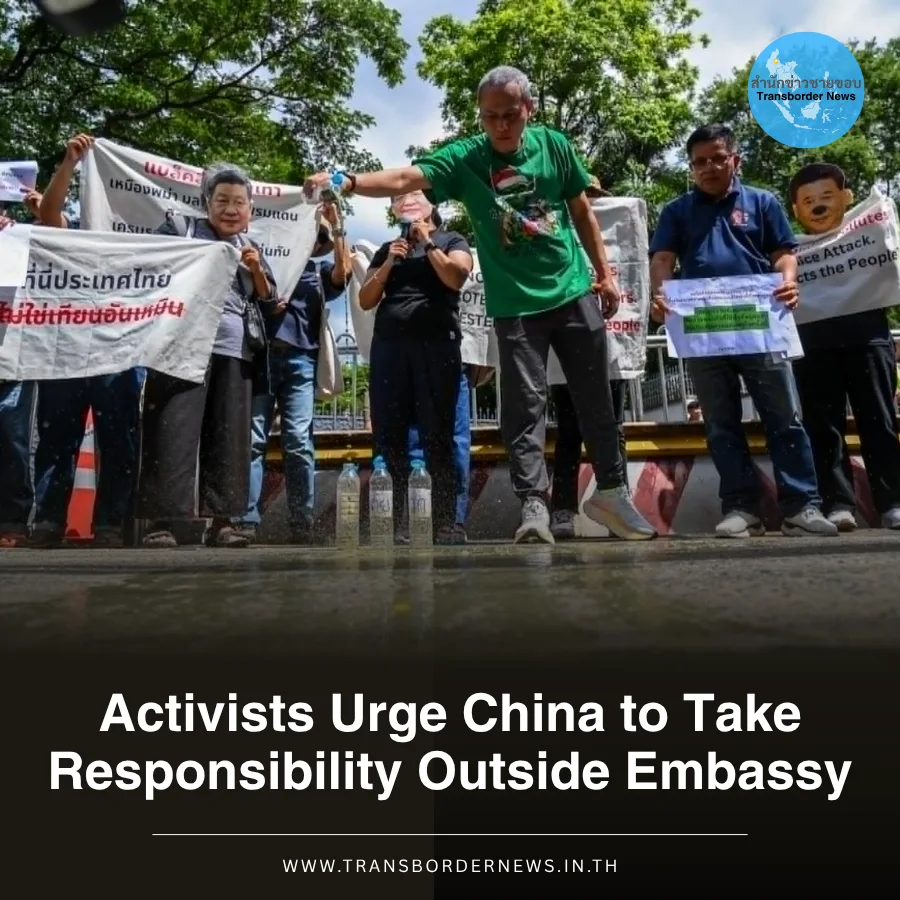
BANGKOK, July 8, 2026 – Around 30 members of the Coordinating Committee of NGOs (NGO-COD) staged a symbolic protest outside the Chinese Embassy in Bangkok on Tuesday, calling on the Chinese government to take responsibility for transboundary river pollution allegedly linked to Chinese-backed mining operations in Myanmar.
The demonstration was also held to demand justice over an incident on July 6 outside the Chinese Consulate in Chiang Mai, where members of the Kok, Sai, Ruak and Mekong River Protection Network said two protesters were injured during a confrontation while attempting to submit a petition.
Police from Huai Khwang Police Station, along with plainclothes and uniformed security officers, erected metal barriers along the embassy’s frontage while leaving pedestrian access open. The Chinese Embassy closed its offices after learning of the planned demonstration. A large number of journalists, particularly from international media outlets, arrived at the scene from about 9.30am.
Protesters carried placards reading: “This is Thailand, not Tiananmen,” “Those polluting the Kok, Sai, Ruak and Mekong rivers are environmental criminals,” and “Blacklist Grey Chinese.” Some demonstrators wore masks depicting Chinese President Xi Jinping.
The group also poured bottles of water they said had been collected from contaminated sections of the Kok, Sai, Ruak and Mekong rivers in front of the embassy before reading a joint statement.
Lertsak Kamkongsak, chairman of NGO-COD, said mining operations in Myanmar had caused transboundary impacts on the Sai, Kok, Ruak, Mekong and Salween rivers.
He said many of the mines were operated by Chinese companies and argued that responsibility could not be separated from the Chinese government because many projects were linked to the Belt and Road Initiative (BRI), under which Beijing often holds equity stakes.
“Chinese private companies cannot be the only ones held accountable,” he said.
Mr Lertsak added that China’s influence in Thailand was expanding beyond river pollution to include what he described as “Grey Chinese” businesses, ranging from scam centres to companies legally registered in Thailand that allegedly engage in fraudulent activities.
He also referred to the collapse of the State Audit Office building, which involved an Italian-Thai and a Chinese construction company, the transport of hazardous waste to eastern Thailand, and underground potash mining in Dan Khun Thot district of Nakhon Ratchasima province.
“We must make it clear that what the Chinese government is allowing to happen on Thai soil is unacceptable,” he said. “We will continue calling for solutions to toxic contamination in our river basins while demanding investigations into Chinese business operations in Thailand, including the widespread use of nominee companies.”
Mr Lertsak also urged members of parliament and senators to intensify their oversight. The network plans to petition parliamentary committees to investigate the issues and work with civil society groups to raise greater public awareness of the impacts of Chinese industries.
“China’s security cannot be built on dying rivers”
In its statement, NGO-COD said it was escalating its demands beyond condemning the violence that occurred on July 6 to exposing what it called “structural truths” that the Chinese government could no longer deny.
The statement urged the Thai government and the international community to confront what it described as the true costs of development under China’s Belt and Road Initiative.
“When the Kok, Sai, Ruak and Mekong rivers are dying and people’s lives are collapsing, the state targets not the polluters but the people who stand up to protect the rivers,” the statement said.
It argued that this reflected a power structure that prioritised the interests of Chinese capital over the rights and wellbeing of affected communities.
“China’s security cannot be built on the death of rivers and communities in Thailand and neighbouring countries,” it said.
The group alleged that projects under the BRI had contributed to pollution in shared river systems, affecting more than one million people in northern Thailand and tens of millions across the Mekong basin through the loss of clean water, food security, public health and traditional livelihoods, while profits continued to flow back into China’s supply chains.
It said “Grey Chinese” was not merely a collection of illegal businesses but “a structure that evades responsibility.”
The statement called on the Thai government to protect citizens and human rights defenders rather than polluters, and to end development models that shift environmental and social costs onto local communities.
Pol Col Sornsak Thongmee, superintendent of Huai Khwang Police Station, said organisers had notified authorities in accordance with the law and police had facilitated the gathering accordingly.
He added that the Chinese Embassy had not requested any additional police deployment and officers were present under normal security arrangements.
Shadow cabinet calls for stricter mineral supply chain checks
At Parliament on the same day, Pattarapong Leelapat, Chiang Mai MP from the People’s Party, said after the party’s eighth shadow cabinet meeting that minerals imported from Myanmar were entering Thailand without proper scrutiny regarding their origin or the companies involved.
He urged the government to issue ministerial regulations requiring due diligence throughout mineral supply chains to prevent Thailand from becoming a transit route for toxic minerals.
“The government has done very little to address pollution at its source,” Mr Pattarapong said.
“There has been only one formal discussion with Myanmar, with no tangible progress despite more than a year passing under the current administration. Deputy Prime Minister Songsak Thongsri, who chairs the national environmental committee, has convened only one meeting.”
Former ambassador urges broader diplomacy
Pisan Manawapat, a former Thai ambassador to the United States, said he sympathised with China over its increasingly negative public image, but said Beijing should recognise that the problem stemmed from the actions of some Chinese businesses, failures to respect international standards, and in some cases, the Chinese government itself.
He urged Deputy Foreign Minister Sihasak Phuangketkeow to devote greater diplomatic effort to resolving the upstream causes of toxic river pollution rather than focusing primarily on issues such as the MOU 44 negotiations and preparations for ASEAN meetings involving Myanmar.
“The Ministry of Foreign Affairs should lead on cross-border river pollution rather than leaving the issue solely to the Ministry of Natural Resources and Environment,” he said.
Mr Pisan also argued that negotiations should not be limited to Myanmar’s government if mining operations were located in areas beyond its effective control.
Citing information from United Nations experts, he said the Chinese government held substantial interests in rare earth mining operations in territories controlled by non-state actors in Myanmar.
“Thailand must communicate diplomatically but firmly with China,” he said. “China must not think it can do anything it wants to Thailand.”
He further suggested that if China failed to take meaningful action, Thailand should deepen cooperation with Japan, Australia, South Korea and the United Kingdom, all of which had expressed interest in supporting efforts to improve environmental safety and public wellbeing in the region.
“Invite the ambassadors of these four countries for discussions, or meet their foreign ministers whenever opportunities arise,” he said. “Elevating these partnerships would send a clear diplomatic message. Those who choose not to cooperate will also receive a clear message.”