
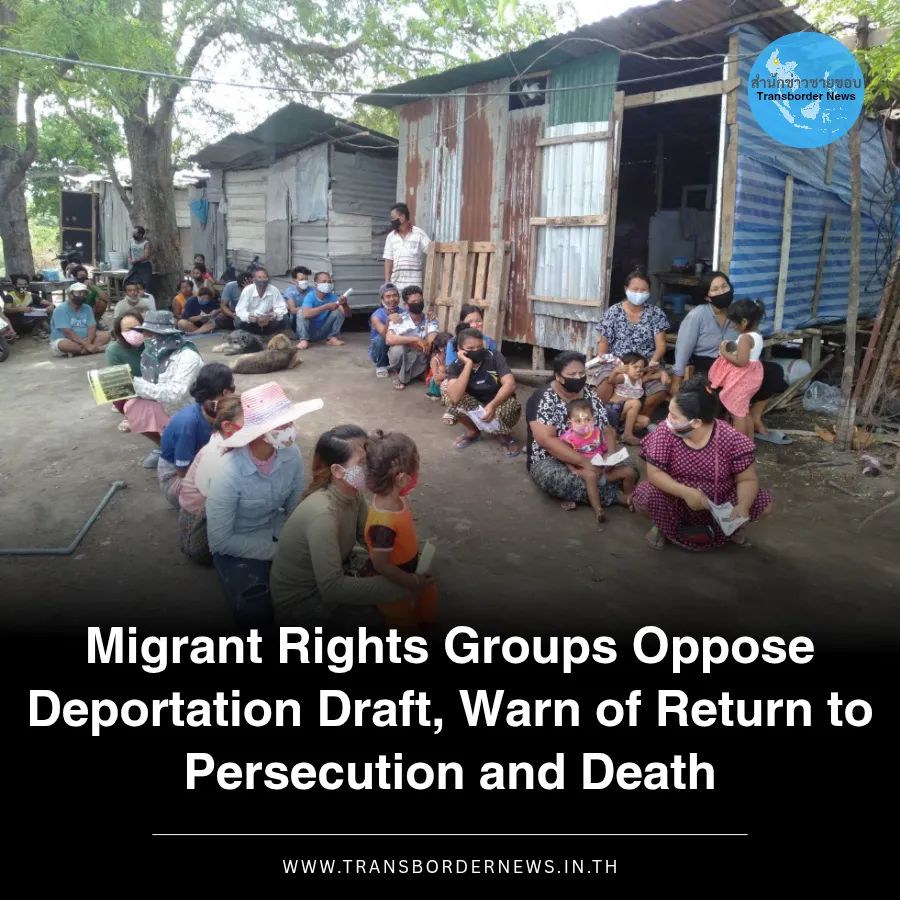
BANGKOK, July 15 — Three migrant and refugee rights networks have urged the Thai government to reconsider a draft Prime Minister’s Office regulation on deportation, warning that it grants overly broad powers to authorities, risks violating Thailand’s obligations under four international human rights treaties, and could put Myanmar migrant workers at risk of being returned to face death.
The Thailand Migration Reform Network (TMR), Migrant Working Group (MWG), and Coalition for the Rights of Refugees and Stateless Persons (CRSP) issued a joint statement on Wednesday after the Cabinet approved the draft regulation in principle on July 14.
The proposed regulation aims to expedite the deportation of foreign nationals from Thailand.
The three civil society coalitions, which advocate for migrant workers, refugees and stateless people, said they recognised the state’s authority to control immigration and deport foreign nationals who violate the law. They stressed, however, that deportation itself is not a human rights violation if carried out in accordance with the rule of law.
“Such powers must be exercised in line with the principle of non-refoulement, due process, individual assessment and proportionality,” the statement said.
The groups said their review of the draft regulation identified at least nine structural concerns that could affect compliance with at least 15 provisions contained in four international human rights treaties to which Thailand is a party.
The treaties include the International Covenant on Civil and Political Rights (ICCPR), the Convention against Torture and Other Cruel, Inhuman or Degrading Treatment or Punishment (CAT), the Convention on the Rights of the Child (CRC), and the International Convention for the Protection of All Persons from Enforced Disappearance (ICPPED).
The statement also raised concerns over the legal hierarchy of the proposed regulation, warning that some provisions could affect Thailand’s foreign relations, leave the country vulnerable to pressure or interference from other states in the exercise of its discretion, and potentially undermine Thailand’s bid to join the Organisation for Economic Co-operation and Development (OECD).
The networks called on the government to:
Suspend promulgation of the draft regulation and reopen consultations with the National Human Rights Commission of Thailand, the Ministry of Foreign Affairs, international law experts, international organisations and civil society before proceeding further.
Incorporate minimum legal safeguards into the draft, including an explicit non-refoulement provision consistent with Section 13 of Thailand’s Prevention and Suppression of Torture and Enforced Disappearance Act B.E. 2565 (2022); individual risk assessments prior to deportation; the right to be informed of the reasons for deportation; access to interpreters and legal counsel; the right to appeal before a court or independent body with automatic suspension of deportation in cases involving serious risk; proportionality assessments; protections for children and families; safeguards governing immigration detention; and limits on re-entry bans together with review mechanisms.
Remove wording in the explanatory memorandum that assesses the intentions or sincerity of foreign governments and international organisations, replacing it with neutral criteria based on timelines and progress in accepting deportees.
Review and reform Thailand’s immigration, screening, deportation and removal laws through the legislative process, particularly by amending the Immigration Act B.E. 2522 (1979), which is currently under consideration by the House of Representatives, rather than relying on piecemeal subordinate legislation.
The groups said this would ensure that all agencies apply the same legal standards and reduce concerns over selective enforcement.
Adisorn Kerdmongkol, coordinator of the Migrant Working Group, said the proposed regulation was overly broad because it would apply to all categories of foreign nationals, including undocumented migrant workers, migrants who had fallen out of legal status, and refugees without formal recognition.
“They could all be deported without any screening mechanism,” he said.
Mr Adisorn argued that the proposal could conflict with Section 13 of the Prevention and Suppression of Torture and Enforced Disappearance Act by allowing executive powers to override primary legislation, creating legal uncertainty in practice.
He also warned that vulnerable groups, including Uyghurs and Rohingya who have spent years in immigration detention, could be deported to countries where they face persecution because the draft contains no appeal mechanism.
“That clearly conflicts with the international principle of non-refoulement,” he said.
Mr Adisorn added that the regulation could pressure officials to accelerate deportations while creating negative economic consequences for employers.
“For example, if migrant workers have not yet been able to change employers or renew their permits, they could simply be deported,” he said.
“In the long run, the government may become dependent on using administrative measures instead of pursuing more sustainable structural legal reforms.”
Moe Kyaw, chairman of the Joint Action Committee for Burmese Affairs (JACBA), told the Karen Information Center (KIC) that the proposed regulation could put the lives of Myanmar migrant workers with political backgrounds or affiliations at serious risk.
For those without political involvement, he said, military conscription could sometimes be avoided through the payment of money.
“But for those with political backgrounds, being deported would be equivalent to being sent back to face death,” he said.
Mr Moe Kyaw acknowledged that the proposed regulation could strengthen Thailand’s national security, but said that for people fleeing Myanmar, it could also mean being forced back into life-threatening danger.
This is a translation of original Thai article https://transbordernews.in.th/home/?p=46964