
5 August 2026, Myanmar activists, students and migrant workers living in Thailand have urged the Thai government not to lend political legitimacy to Min Aung Hlaing, saying the junta leader has failed to bring peace to Myanmar and is himself responsible for many of the problems affecting both countries.
Their comments came ahead of Min Aung Hlaing’s visit to Thailand, amid widespread criticism of his role as leader of the 2021 military coup and the continuing human rights crisis in Myanmar. Many Myanmar nationals have been displaced internally or forced to seek refuge and employment abroad.
Brang Min, a Myanmar activist, said Thailand should not officially welcome a military leader whose actions had contributed to instability, civil war and widespread violence.
He said the consequences were not confined to Myanmar, but had also affected Thailand through refugee movements, migrant labour issues, organised crime and transboundary environmental pollution.
“Thailand should seek a comprehensive understanding of Myanmar’s problems,” he said. “Although the two countries share interests in areas such as migrant labour and transboundary pollution in the Kok River, Min Aung Hlaing is not capable of resolving these issues. In fact, he has helped create the problems in Myanmar, and their effects have spread into Thailand.”
Mr Brang Min said the Thai government should engage with all relevant parties in Myanmar rather than dealing exclusively with the junta leader.
“Speaking only with Min Aung Hlaing will not provide a sustainable solution for either Myanmar or Thailand,” he said.
Asked whether he retained hope for Myanmar’s future, Mr Brang Min said he believed the country would eventually regain stability, genuine freedom and free elections, although he did not know when that would happen.
Thailand and Myanmar share a long border and close economic, commercial, cultural, religious and environmental ties, he said. Stability in Myanmar would also benefit Thailand, while continuing conflict would inevitably create further consequences for its neighbour.
“I am grateful to the Thai government and Thai people for providing refuge to displaced people, refugees and migrant workers from Myanmar,” he said. “But the Thai government should not support Myanmar’s military regime, because doing so will not contribute to lasting peace and stability in the region.”
Sam Kham, a pseudonym used by a Shan migrant worker in Chiang Mai, said talks between the Thai and Myanmar authorities had direct implications for Myanmar workers in Thailand.
The conflict affects their ability to return home, obtain documents, work legally and ensure the safety of family members who remain in Myanmar, he said.
“The Thai government should listen to the people of Myanmar, not only to the military government,” Mr Sam Kham said. “If the talks bring no change, ordinary people will continue to suffer.”
He said migrant workers should not be viewed merely as a source of labour.
“We are people with families and feelings, and we are directly affected by what is happening in Myanmar,” he said.
San San, a pseudonym used by a Myanmar student studying in Thailand, called on the Thai government to affirm its support for democracy and oppose violence by Myanmar’s military authorities.
She also urged Thailand to support educational opportunities for young Myanmar nationals forced to flee the conflict.
“Many young people have been displaced by this situation,” she said. “There should be cooperation that allows them to continue their education.”
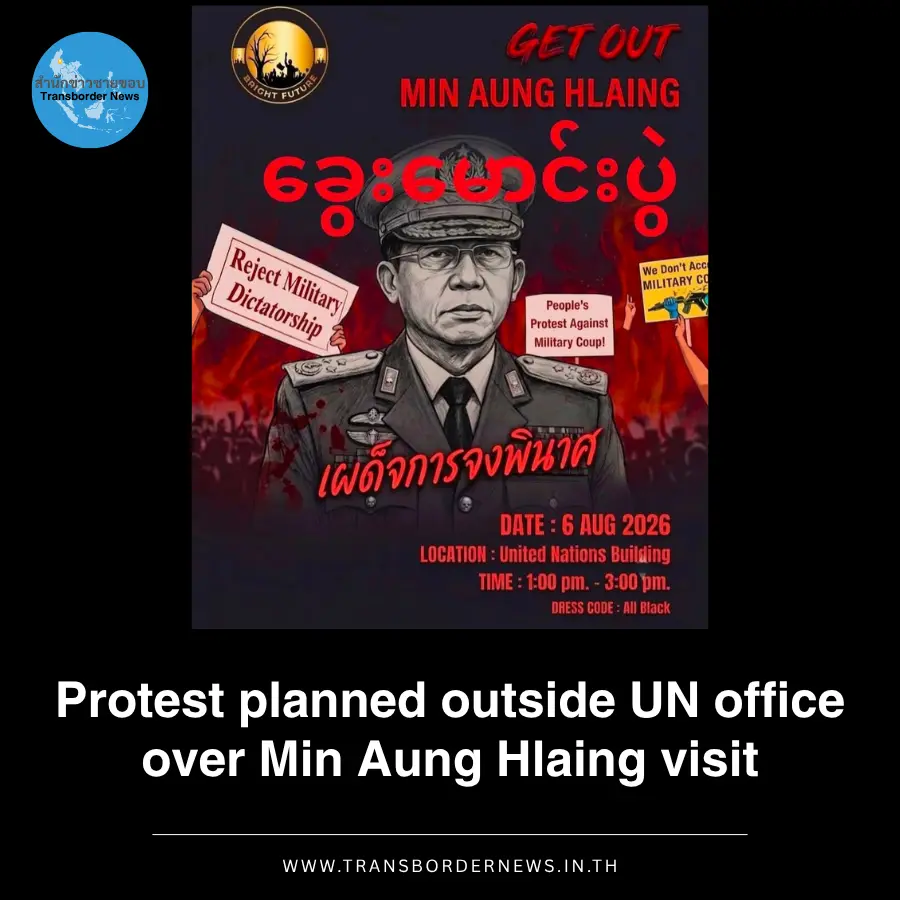
Meanwhile, the Bright Future Network, whose members are mainly Myanmar migrant workers, said it would hold a symbolic protest outside the United Nations office in Bangkok on Aug 6.
Network founder Surat Kiri said the gathering had received police permission and would take place from 1pm to 2pm. Participants planned to hold placards, call for democracy in Myanmar and read a statement rejecting Min Aung Hlaing’s visit.
Mr Surat said he understood that Thailand needed to communicate with Myanmar because the two countries share an extensive border.
However, he said many of the problems along that border had worsened during Min Aung Hlaing’s leadership, including the expansion of drug production in Shan State and scam compounds in Karen State.
“These problems cannot be resolved simply by talking to Min Aung Hlaing,” he said. “The Thai government should also listen to information and perspectives from the other side.”
Mr Surat criticised the decision to invite the junta leader, saying the Thai government appeared to assume that he remained the sole authority capable of controlling Myanmar.
“Since the military coup five years ago, large areas of Myanmar have come under the control of ethnic armed organisations and other resistance forces,” he said. “The government should also provide a platform for those voices.”
The campaign poster circulated by Myanmar nationals in Thailand calls for opposition to Min Aung Hlaing’s visit.
This is a translation of the original Thai news article.