
UBON RATCHATHANI – The reopening of the Pak Mun Dam gates has brought renewed economic activity and restored fish migration along the Mun River, prompting affected communities to call on Prime Minister Anutin Charnvirakul to permanently open the dam. Villagers say they have endured 36 years of hardship since the dam was built, with conflicts over the project tearing apart families and communities.
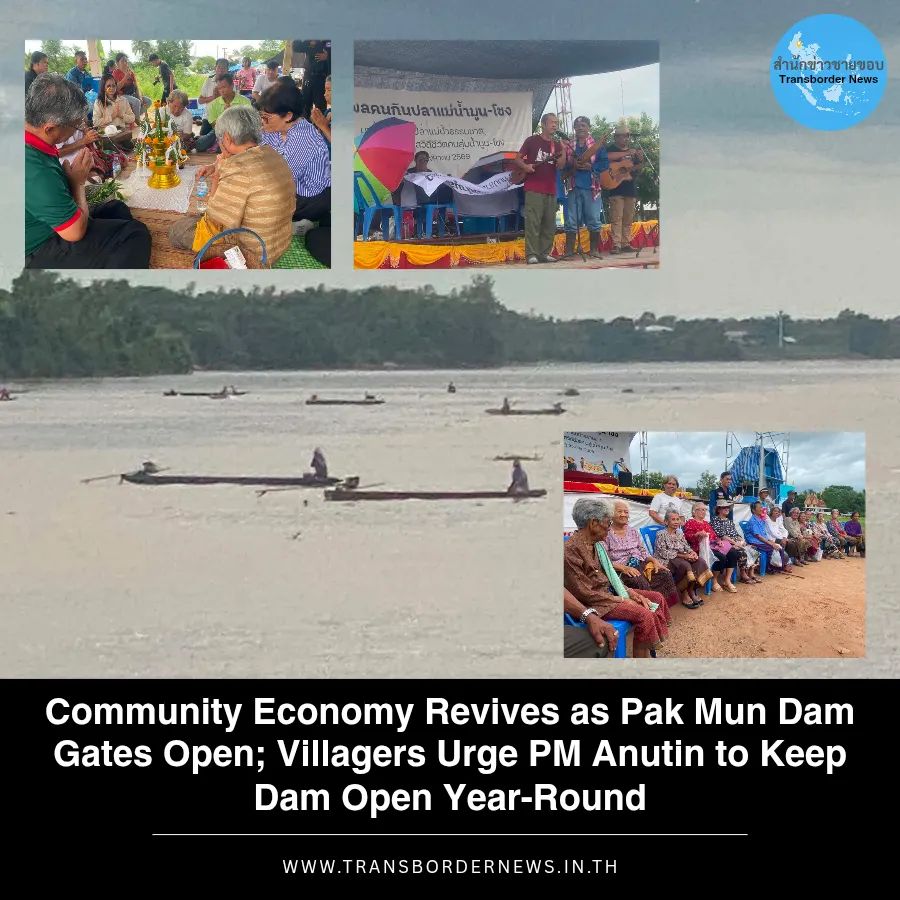
About 200 villagers gathered on Saturday at Wang Sabaeng Tai fishing pier in Khong Chiam district for the event, “Mun-Mekong Fish Feast Gathering”, organised by residents living along the lower Mun River. The celebration came just over a week after the Electricity Generating Authority of Thailand (EGAT) opened the dam’s sluice gates on July 30.
Fishing activity along the river was visibly bustling as fishers hauled in their catches and local fish traders reported brisk business.
Sompong Wiangchan, representing the Assembly of the Poor’s Pak Mun Dam campaign, said 55 villages had been affected by the construction of the dam.
“For fishers, opening the dam gates has never been easy. It has taken decades of struggle. Today, the river flows freely again, allowing fish to migrate upstream to spawn, while we can once again make a living from fishing,” she said.
She said the gathering reflected the determination of people from all 55 affected villages to protect the Mun and Mekong rivers as sustainable food sources for future generations.
Suriyan Wannawong, Ubon Ratchathani’s provincial fisheries chief, who presided over the event on behalf of the governor, said communities along the Mun and Mekong rivers had relied on fisheries for generations.
“Fish stocks have declined steadily due to many factors, but this year local fishers have reported noticeably larger catches from both the Mun and Mekong rivers,” he said.
The event also featured the reading of an open letter addressed to Prime Minister Anutin.
“We have never asked for anything beyond our rights as citizens,” the letter said. “For 36 years we have lost our river, our livelihoods, our food, our family security, and precious years waiting for justice.”
The villagers stressed that they were not seeking compensation alone, but the restoration of a river that had sustained their communities for generations.
Before the dam was built, they said, families could catch fish throughout the year and no one went hungry because the river provided food for everyone. That changed after the dam was completed.
The letter called on the government to:
Expedite compensation payments to all affected people and their heirs.
Permanently open the Pak Mun Dam gates to restore the river’s natural flow, fish migration, livelihoods and food security.
Introduce special rehabilitation measures for Ban Hua Wae village, which has suffered the most severe impacts from changes to the river.
Ensure communities participate in decisions concerning the future of the Mun River and apply lessons from Pak Mun to all future dam projects.
The gathering honoured 13 elderly villagers, aged between 73 and 89, who have participated in the campaign since its early days, symbolising a struggle that has spanned more than three decades.
During a public forum titled “Open the Dam, Restore the Fish, Revive the River: Livelihoods and Food Security in the Mun-Mekong Basin”, Ms Sompong recalled how the long-running dispute over whether the dam should remain open or closed had divided communities.
“We have fought with our hearts and dedicated our lives to this river. Some wanted the dam open, others wanted it closed. The conflict has been painful, but we have continued because the truth about the impacts on fishing communities must be recognised,” she said.
Pha Kongtham, a representative of communities affected by the Rasi Salai Dam, said the closure of Pak Mun Dam had consequences far beyond the immediate area.
“The river is the lifeline of our communities. Fish migrate from the Mekong into the Mun River. Blocking the river in stages has created stagnant reservoirs overrun by aquatic weeds,” she said.
“The divisions have gone beyond policy disagreements. Families and communities have split apart. In some cases, people were no longer willing to attend each other’s funerals.”
Wai Pongphim, a villager from Ban Tamui, warned that another proposed hydropower project—now renamed the Salawan Dam, formerly known as the Ban Kum Dam—would threaten communities along the Mekong.
“If this dam is built, Ban Tamui will not survive. Our forests will disappear, and we will have nowhere to go,” he said, urging the river network to unite against the project.
Chaiwut Krutphan, a fisheries academic at Ubon Ratchathani University’s Faculty of Fisheries, said the Mun River forms a vital ecological artery for northeastern Thailand.
He said research has documented seasonal migration routes of numerous fish species between Cambodia, Laos, the Mekong and the Mun River. Floodplains such as Rasi Salai serve as important breeding grounds, while recent observations indicate the return of pla mak phang—known as the freshwater mackerel—which had disappeared from the river system for years.
“The river network functions like a circulatory system,” he said. “Small tributaries are just as important as the Mekong itself in sustaining fish migration.”
Environmental activist Harnnarong Yaowalers said the Pak Mun Dam had already exceeded its intended economic lifespan.
“The dam is now more than 35 years old, while its economic lifespan was estimated at 25 years. Delaying the opening of the gates has clear ecological consequences. Once it is time to open them, they should be opened without delay. The government’s response to people’s demands has consistently been too slow,” he said.
The event concluded with a traditional bai sri su khwan ceremony to bless the Mun River.
Sudarat Pitakpornphallop, a Bhumjaithai Party MP, attended to receive the villagers’ letter and pledged to forward their concerns to the relevant authorities.
Local fishers told reporters that since the dam gates were opened, their daily income had increased by at least 1,000 baht, while fish wholesalers reported earning tens of thousands of baht a day, bringing a significant boost to the local economy.
This is a translation of original Thai news article https://transbordernews.in.th/home/?p=47299