
CHIANG MAI, Aug 15, 2026 – China’s crackdown on illegal rare earth mining within its own borders has pushed Chinese investors to expand operations across the border in Myanmar, fuelling environmental damage and transboundary river pollution, researchers said at an international conference on Myanmar studies on Friday.
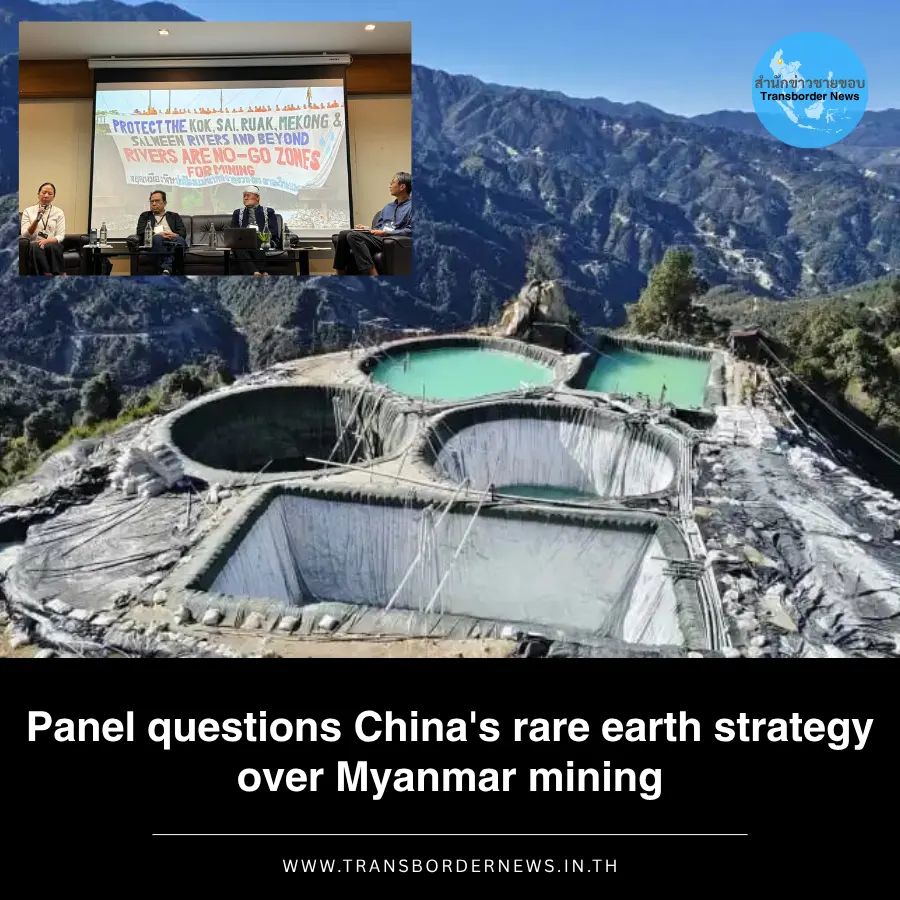
The issue dominated one of the best-attended sessions on the second day of the 5th International Conference on Burma/Myanmar Studies, held at Chiang Mai University’s Academic Service Centre. The panel, titled “Rare Earth: Extractive Industry, Global Supply Chain and Transboundary Water Pollution,” featured Kachin researcher Seng Li of Chiang Mai University’s Regional Center for Social Science and Sustainable Development (RCSD), environmentalist Tara Buakamsri, director of Climate Connector, and Pianporn Deetes, co-founder and executive director of the Rivers and Rights Foundation. The discussion was moderated by Gary Lee, program director of the foundation.
Seng Li said rare earth mining in Myanmar’s Kachin State had expanded dramatically following the 2021 military coup. Data compiled by Myanmar Witness identified about 400 mining sites in Kachin, accounting for nearly 90% of Myanmar’s rare earth operations.
He attributed the surge to rising global demand and China’s domestic crackdown on illegal mining, which prompted Chinese investors to relocate extraction activities to Kachin while continuing to ship raw materials back to China for processing.
“Rare earth mining has become an important source of revenue for the Kachin Independence Organization (KIO), particularly after the 2021 coup, when the Kachin Independence Army (KIA) required funding to sustain its armed resistance against the military junta,” Seng Li said.
He noted that the KIO introduced a new regulatory framework in 2025 covering taxation, export checkpoints, foreign labour and anti-narcotics measures. However, enforcement remains weak, particularly in addressing environmental damage caused by mining chemicals contaminating headwater streams, landslides, poor labour protection and the exploitation of female workers at mining sites.
Seng Li said the KIO urgently needed to enforce its own regulations more effectively while the international community should engage more directly with ethnic armed organisations by providing technical assistance to strengthen transparent and sustainable natural resource governance.
“The international community has largely overlooked ethnic armed organisations as non-state actors in natural resource governance,” he said.
Tara Buakamsri said satellite imagery showed rare earth mines scattered across Kachin and Shan states, releasing contaminated wastewater into the Irrawaddy, Salween and Mekong river systems.
Citing a Global Witness report, he said China imported 41,700 tonnes of the heavy rare earth elements dysprosium and terbium from Myanmar in 2023, accounting for 98% of its total imports of those two critical minerals. The materials are essential for manufacturing high-performance magnets used in electric vehicles, wind turbines and advanced technologies.
“Rare earth mining in Myanmar is not simply a problem of weak governance in one country. It has become China’s single point of failure,” Mr Thara said.
“Although China controls about 99% of the world’s heavy rare earth separation and processing capacity, it cannot supply itself with enough raw materials. It remains dependent on minerals extracted outside the rule of law in the midst of Myanmar’s civil war.”
He cited the KIA’s capture of key mining areas in 2024, which caused China’s rare earth imports from Myanmar to fall by nearly 90% within a month.
He also pointed to the emergence of dozens of new rare earth mines after the Ta’ang National Liberation Army (TNLA) lost revenue from ruby mining in Mogok, describing it as a clear example of the “resource curse”, where environmental commitments are abandoned when armed groups face financial pressures.
Mr Tara compared China’s rare earth processing industry to “a giant coffee grinder” that blends ores from multiple sources, making it virtually impossible to trace their origin. He warned that the same unregulated mining model was now expanding into Laos.
“This is no longer just a business issue. It is a geopolitical issue,” he said. “Chinese state-backed capital is effectively using Myanmar as a sacrifice zone. It is time for global downstream brands and international climate negotiations to address rare earth supply chain governance and the rights of Indigenous communities.”
Pianporn Deetes said transboundary pollution from mining activities in Shan State and other border areas of Myanmar was worsening and directly affecting Thailand’s river systems.
She cited monitoring data from the Pollution Control Department’s Office of Environmental and Pollution Control Region 1 in Chiang Mai, which has detected arsenic concentrations exceeding safety standards in the Sai River for more than two years. The river serves as an important source of raw water for irrigation and community water supply systems.
Sediment samples collected from the Mekong River at the Golden Triangle in Chiang Rai’s Chiang Saen district showed arsenic concentrations around ten times higher than levels considered hazardous to aquatic life. Reports of diseased and deformed fish have also become increasingly common.
“Mining in unregulated areas is expanding rapidly from Kachin and Shan states into the Salween and Tanintharyi regions,” Ms Pianporn said. “Satellite imagery and field observations show heavy machinery operating around the clock. The most alarming change is that river sediment, once a natural source of nutrients, has become contaminated with arsenic and other heavy metals, threatening the health, livelihoods and food security of river communities.”
She warned that the Salween River, which environmental groups and indigenous communities have spent more than 25 years campaigning to keep free-flowing, is now also facing arsenic and mercury contamination. Communities downstream in Mon State have begun questioning whether the river remains safe for agriculture.
She also expressed concern over a planned 2,790-megawatt hydropower project jointly studied by Myanmar and Laos upstream of the Golden Triangle. The project, if built, could trap contaminated sediments in the Mekong, effectively turning the reservoir into “a toxic reservoir” while increasing risks for downstream communities.
Ms Pianporn criticised Thai authorities for failing to act despite having access to satellite imagery and intelligence on mining expansion.
“The recently signed Terms of Reference (TOR) between Thailand and Myanmar does not address the root cause of the crisis because mining itself is absent from the agreement,” she said.
She called for all major rivers—including the Kok, Sai, Ruak, Mekong, Salween and Kraburi—to be designated permanent no-mining zones.
“There is nothing more important than protecting our drinking water, our soil and the food security of future generations,” she said.
The session drew such a large audience that organisers had to bring in additional seating. Participants raised questions about whether the Thailand-Myanmar TOR could restrict public disclosure of future water, sediment and food contamination data, and how regional and international accountability mechanisms could be developed for rare earth supply chains serving global industries such as electric vehicles, aerospace, defence and renewable energy.
This is a translation of original Thai news article
https://transbordernews.in.th/home/?p=47377