
Hill Area and Community Development Foundation (HADF)
September 2026
This report was originally prepared in Thai by the Hill Area and Community Development Foundation (HADF). This English translation has been prepared to make the findings and perspectives from border communities accessible to a wider regional and international audience.
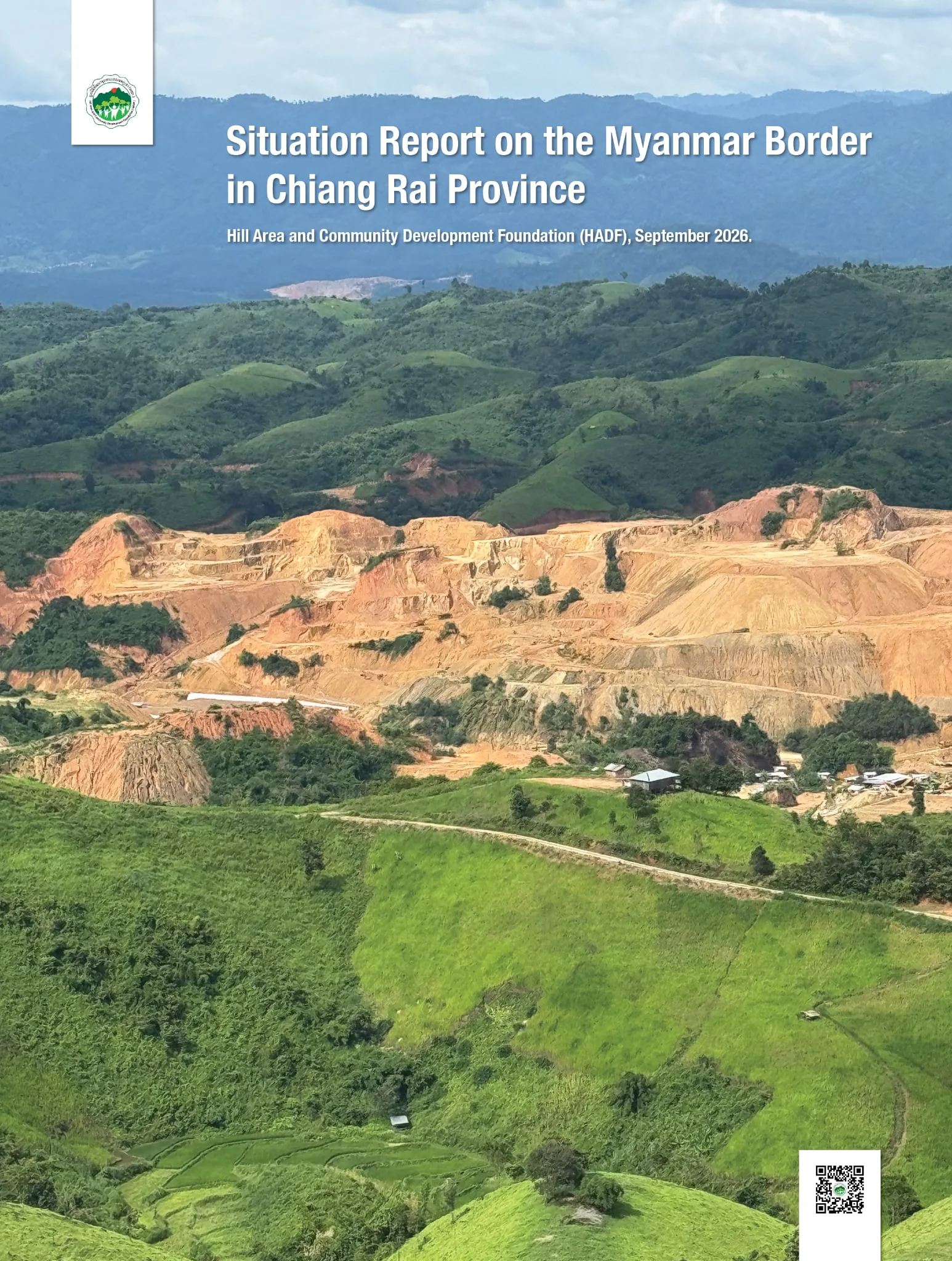
From 2024 to 2026, border areas between Chiang Rai Province in northern Thailand and eastern Shan State, Myanmar, have faced interconnected environmental and humanitarian crises. Among the contributing factors are the political situation in Myanmar and the expansion of gold mining, critical minerals, rare earth elements (REEs), and other mining activities in Shan State and the Mekong Basin.
The Hill Area and Community Development Foundation (HADF) is a Thai public-benefit organization that has worked for more than 40 years to support education, improve quality of life, conserve natural resources, and promote access to rights for people and communities in the border areas of Chiang Rai Province. This long-term engagement has brought HADF into close contact with communities, women’s groups, local leaders, religious leaders, children, and young people on both sides of the border.
HADF has found that the challenges facing the border region have grown beyond environmental pollution or any single issue. They have developed into an interconnected crisis affecting human rights, food security, health, livelihoods, culture, human security, and national security.
Field information indicates that many people have lost livelihoods and income, as well as confidence in the safety of rivers and natural resources on which they have long depended. Of particular concern is the loss of community access to these resources. In eastern Shan State, communities report land seizures, forced military recruitment, human rights violations, and expanding mining activities. Together, these pressures are contributing to continued migration into Thailand.
In 2024, the Kok River, which flows from Shan State into Thailand, remained unusually turbid for extended periods. Similar changes had already been observed in the Sai River. In September that year, severe flooding and mudslides struck the region. In 2025, testing subsequently detected heavy metals exceeding applicable standards in the Kok and Sai rivers, while extensive land clearing associated with mining was identified in the upper watersheds of both rivers.
The floods and mudslides of 2024 did more than draw attention to mining activities in the headwaters. They also exposed a broader set of changes taking place across the borderlands.
Key Findings
- Transboundary toxic pollution is undermining the foundations of life on both sides of the border
Communities living along affected rivers in Shan State consistently report that waterways that once sustained food, income, and everyday life can no longer be used as before. Communities report land being taken for mining and rubber plantations, the loss of farmland, contamination of headwaters and rivers, and stream and river ecosystems being damaged by sedimentation. Fish and other aquatic life have declined or disappeared in some areas. Community members in several locations also report that they cannot safely gather to discuss, criticize, or oppose mining activities because they fear punishment or disappearance.
Conditions in border communities in eastern Shan State have deteriorated further since the 2021 military coup. According to community accounts, forests that local people had worked to protect have been cleared for mining, while opportunities to make a living have steadily diminished. Communities that once sustained themselves through riverside agriculture and the seasonal collection of forest products increasingly find these livelihoods no longer viable as forest resources decline. At the same time, concerns over river contamination have made people reluctant to consume crops grown in areas perceived to be affected.
- Cultural and spiritual impacts remain largely overlooked
Rivers are more than sources of water. They are part of community identity and are deeply embedded in cultural practices, beliefs, and religious life. As river-dependent livelihoods and ways of life are severely disrupted, often without adequate compensation or remedy, many affected people feel they have been left to cope with the consequences on their own.
“The river is like our mother. In the past, we could drink from it, swim in it, catch fish and crabs, gather vegetables, and make a living along its banks. But now that the river is contaminated, the pollution is affecting all of us. The river is dying before our eyes. Our mother is sick, but no one is taking care of her. We want our mother back.”
— An ethnic community spiritual leader
Toxic contamination is therefore affecting an entire cultural ecosystem—a form of loss that has yet to be adequately recognized or assessed.
- Mining continues to expand in the headwaters of the Kok and Sai rivers and Mekong tributaries in Myanmar, intensifying pressure on communities and ecosystems
Forests and headwater areas continue to be cleared for new mines and the expansion of existing operations. Field information indicates that mining activity along the eastern Shan State border continues to grow, while weak governance, restricted access, and ongoing conflict make independent monitoring, impact assessment, and law enforcement extremely difficult.
Border sources describe parts of eastern Shan State as areas where effective state oversight is limited. Myanmar military positions and bases of the United Wa State Army (UWSA) are present across parts of the area, yet local communities report little effective environmental regulation or enforcement.
The expansion of mining has made daily life increasingly difficult for many communities. Residents report being pressured to sell land at low prices or losing access to land altogether. As legitimate livelihoods and the natural-resource base contract, some community sources report that people are being drawn into illicit economies, including drug transportation, with serious consequences for families, children, and community safety.
“Our home used to be rich in forests. Now it is becoming rich in drugs. When villagers have no work, some are hired to carry drugs across the border because it is a quick way to earn money. Some have been shot and killed. There are now many orphans and widows in our communities, and fewer men. Families are poor, and many children are not able to go to school.”
— An ethnic community leader
Along the Kok River in Mong Hsat Township, community sources report several mining dredges operating in the river. Local workers are reportedly paid around THB 300 per day, while those working with machinery may earn approximately THB 7,000–9,000 per month. Work is organized in shifts because some machinery operates around the clock.
Community leaders report that some mine operators or those responsible for paying workers are Chinese nationals. HADF has not, however, been able to independently verify the ownership structures of these operations. Community sources have also reported at least three new mining sites in the hills around Mong Hsat over the past two months that appear similar in form to rare earth mining operations. Further independent investigation is needed to establish the minerals being extracted and the methods used.
A similar pattern has been reported in the Sai River watershed around Tachileik Township, where community sources describe extensive mining along rivers and streams, with machinery operating around the clock. They report that mining has expanded significantly since 2023 and that much of the activity is associated with gold extraction.
“In the past, there were so many fish in the Sai River and the streams that we could catch them by hand. We could put a cooking pot on the fire and go out to catch the fish for our meal. Now the Sai River has been badly damaged. Mining sends mud and sediment into the river, covering the rocks where fish and crabs used to live. People used to grow vegetables along the Sai River and its streams. Since the mining came, the water has turned red and muddy. We are worried about contamination. We can no longer catch fish or grow crops along the river. We have lost our livelihoods and our work.”
— A resident living along the Sai River in Shan State
Traditional communities living on small plains and mountain ridges also report displacement as mining expands into their areas. Some have crossed into Thailand after forests were cleared and land previously used for rice cultivation and rotational farming was taken over. Community members report being pressured to sell land at low prices, with some saying they risk losing the land if they refuse.
Residents living near some mining areas have also raised concerns about chemicals used in mineral processing and the safety of workers. They report that most local workers do not know what substances they are handling, while information about production processes and waste management remains extremely limited.
“They came to extract minerals and open mines. The chemicals they use appear very strong, but villagers cannot read the Chinese labels. Local people take whatever small jobs they can find in the mines. We have heard of workers suffering serious injuries after coming into contact with chemicals. We see different operators at the mines, and the people running them speak Chinese. The mining ponds are lined with plastic. We are told that the minerals are taken to China.”
— A resident of a community near a mining area
These accounts require further independent verification, particularly regarding the substances used, mine ownership, mineral destinations, and the relationship between individual mining sites and downstream contamination.
- Military recruitment is placing growing pressure on young people and families in Myanmar
Field information indicates that fear of military recruitment has become an important source of pressure on young people and families in eastern Shan State. Many have left their communities. Some have sought refuge in forests, while others have travelled to Thailand in search of work and safety.
Some communities also report collecting money from individual households in an effort to prevent family members from being recruited. For households already struggling with declining incomes, these payments create an additional burden.
- Growing numbers of people from Myanmar are moving into Thailand
Over the past three to four years, people from eastern Shan State have continued to enter Thailand through both formal border crossings and informal routes along the Chiang Rai border. They include children, working-age adults, families, and older people.
Their circumstances vary. Some stay with relatives who migrated earlier, while others pay brokers to arrange travel or documentation, with costs varying according to the type of documents or arrangements involved.
Almost all of the people interviewed by HADF said that once they had left, they did not expect to return permanently to their former communities. Some said their land had already been taken and their homes were gone, while families and neighbours had dispersed in different directions. Community sources describe some villages in Shan State as having been substantially depopulated.
Through its field work along migration routes and in border communities, HADF has also observed a growing number of children and young people arriving in Thailand. Conditions in Myanmar have severely constrained access to education in many areas, leading families to seek opportunities for their children to continue their education in Thailand.
- The costs of development are falling disproportionately on communities that benefit least from resource extraction
Field information points to a significant imbalance, particularly in relation to the mining sector. The beneficiaries of mineral extraction and global supply chains may be far removed from the headwaters where extraction takes place, while the environmental, health, economic, and social costs are borne by border communities and people living downstream.
HADF believes that responses must move beyond managing impacts after they occur. Greater cooperation is needed to prevent harm at its source, ensure transparent disclosure of information, strengthen mineral traceability, and ensure that mining operators and businesses throughout the supply chain take responsibility for impacts connected to their activities, in line with the Polluter Pays Principle and international principles on business and human rights.
Under the UN Guiding Principles on Business and Human Rights (UNGPs), businesses have a responsibility to respect human rights. This includes identifying, preventing, and addressing human rights risks associated with their own operations, business relationships, and supply chains, including where impacts occur across national borders. In the minerals sector, responsibility therefore extends beyond the mine itself: buyers, traders, processors, investors, and companies that use minerals as inputs should exercise appropriate human rights due diligence, strengthen traceability, and take steps to prevent and mitigate adverse impacts linked to their supply chains.
For HADF, the purpose of raising these concerns is not to assign blame to any country or people. It is to help build conditions in which communities on both sides of the border can live together in safety and dignity, with opportunities for a better future—and with rivers and natural resources that can continue to sustain generations to come.