
Kanokwan Manorom
Mekong Sub-region Social Research Center, Faculty of Liberal Arts, Ubon Ratchathani University
—–
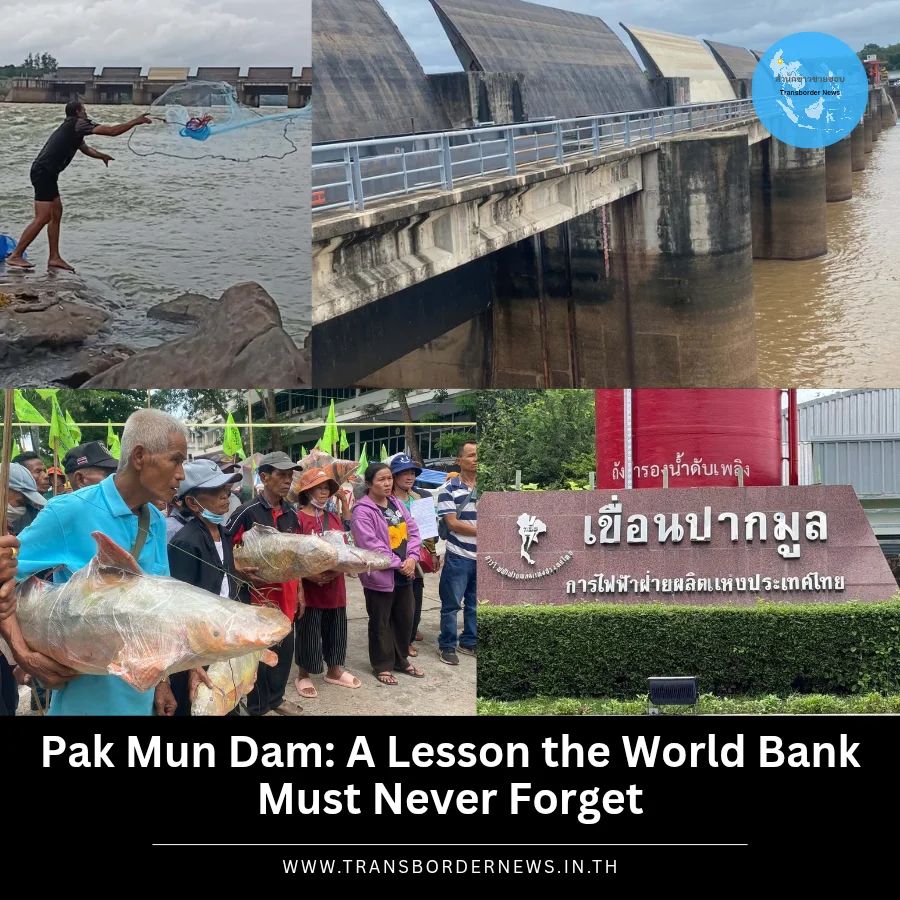
World Bank and Hydropower: promises of development, decades of losses
Why does the World Bank help finance large dams in developing countries around the world? The answer we often hear is electricity generation. Countries need electricity for homes, public and private facilities, shops, industrial factories, the service sector, and other uses. Governments can then use revenue from electricity sales to develop their countries and reduce poverty. Today, hydropower is also presented as an energy source with lower carbon emissions than other sources. These arguments lead many people to believe that dam construction should continue to be considered.
Yet there is another cost that is harder to see. Dams obstruct fish migration, causing fish populations to decline and disappear. Income from fishing is lost. People whose livelihoods depend on rivers must struggle to adapt in order to survive, while spending decades demanding that the state acknowledge their losses (1,2,4,6). Profits from dam construction have continued steadily over many years, but the loss of community ways of life has never been counted as seriously as the megawatts of electricity generated for sale.
This is the story of Pak Mun Dam in Ubon Ratchathani Province, a project that received financial support from the World Bank. The Electricity Generating Authority of Thailand (EGAT) completed the dam in 1994. More than thirty years later, villagers are still demanding compensation for the loss of their fishing livelihoods, the opening of the dam gates, and fair compensation for affected occupations (1,2,4).
Pak Mun is not the only case.
Research on dams elsewhere also shows why we need a broader understanding of their impacts. Downstream communities are often overlooked when projects focus only on the dam and its reservoir. In Laos, for example, people downstream of the World Bank-supported Nam Theun 2 Dam have experienced changes to the Xe Bang Fai River. This case reminds us that dam impacts travel along rivers, and that some become fully apparent only after construction (11).
Living with a dam and prolonged injustice should no longer be accepted as normal
Following the construction of Pak Mun and other dams, the World Bank revised several policies, placing greater emphasis on environmental and social risks and establishing complaint mechanisms for affected people. These changes may indeed be considered progress, and the World Bank says it has learned from Pak Mun. But what do these lessons mean for villagers who have lived for so long with the consequences of changes to the Mun River (4).
Pak Mun Dam was planned to generate electricity to support national growth. It is located near the point where the Mun River joins the Mekong. This location matters because fish migrate between the two rivers. For generations, people along the Mun have depended on these fish for food, income, and their way of life (3). When the dam blocks fish migration, the impacts extend beyond the immediate dam site. Fishers throughout the river basin find it harder to catch fish, activities along the riverbanks change, and families must find new ways to earn a living. Fishers have demanded that the gates be opened permanently, or for longer than four months, or that villagers instead receive 15 rai of land per household as compensation (10).
Pak Mun became known around the world because villagers refused to let these impacts be dismissed as minor or temporary. They have spent more than 30 years protesting, negotiating, and sharing their knowledge of the river. The World Commission on Dams subsequently studied Pak Mun and six other dams around the world to review the problems associated with large dams in different countries. This work posed questions to the World Bank, governments, and dam owners: Who benefits? Who bears the costs? And do affected people have a genuine right to participate in decisions before a project begins (10,11)?
These questions are crucial. For more than 30 years, the dam has generated electricity and profits, while villagers have had to live with the permanent loss of fishing income, ways of life, fishing knowledge and culture, and rituals connected to the Mun River. The tension between these two outcomes reveals the injustice experienced by communities affected by a World Bank-supported dam.
Pak Mun villagers have made considerable efforts to adapt, while continuing to struggle, mobilize, and oppose the dam. In their everyday livelihoods, some still fish when opportunities arise during the four months in the rainy season when the gates are open. In practice, however, gate opening rarely coincides with fish migration from the Mekong into the Mun. Many villagers farm, trade, or seek wage work elsewhere. Many households combine several kinds of work with fishing as fish populations decline or the composition of fish species changes. Although these efforts demonstrate their ability to survive, such adaptations have not secured sustainable community livelihoods.
Compensation in money or land cannot restore river ecosystems and livelihood security
Fair compensation is essential. Across two-three generations, Pak Mun villagers have collectively devoted immense physical effort, emotional energy, and time to demanding compensation. They must attend meetings, gather documents, travel, wait, and recount the same experiences at every meeting concerning annual gate opening and compensation for the permanent loss of fishing livelihoods. Each time they mobilize to press their claims, villagers lose their daily income. The longer this process continues over the years, the greater their physical and psychological losses become (8). Waiting for fair compensation has itself become an additional burden on top of the losses they have already suffered.
Of course, financial compensation or the provision of land cannot bring everything back. It cannot restore the years when people could not fish, or guarantee that children will learn about the river from their grandparents. But this does not make compensation any less important. Fair compensation should go hand in hand with river restoration and genuine participation by affected people in river management (8,10).
What has the World Bank learned?
The independent World Commission on Dams (WCD) proposed a new framework for assessing dams and their social and environmental consequences. Its recommendations helped reshape international debate about how dams should be assessed, which issues assessments should cover, and who should participate in decision-making (3). However, these recommendations should not be treated as World Bank policies: the Bank did not fully adopt them, and its response remained contested. (4,5).
In my view, these questions are extremely important, but substantial limitations remain because key fundamental questions are still unresolved: Has the World Bank given sufficient attention to social and environmental costs, and in what ways? Why does debate on this issue continue without resolution? At Pak Mun, for example, the relevant agencies have still not answered these questions: How can we know whether EGAT, as the dam owner, and successive governments over more than thirty years have done enough to address these problems, when affected people continue to live with their losses and have waited so long for fair compensation, restoration, and redress?
The World Bank has sought to demonstrate that subsequent dams can be planned more carefully. Its support for Nam Theun 2 in Laos was linked to poverty reduction goals, environmental measures, and monitoring. Yet research has questioned how meaningful participation has actually been and whether downstream impacts have been investigated adequately. This case must be scrutinized against what actually happens after the dam begins operating (11).
Responsibility for problems caused by dam construction must also be assigned in accordance with the facts. Although the World Bank financed the dam and its contract with the dam owner has ended, this does not mean that the World Bank no longer bears responsibility.
Pak Mun Dam: A test the World Bank must never forget
In 2000, the World Commission on Dams published recommendations calling for greater attention to the social and environmental dimensions of dam construction. It stated that alternatives must be seriously considered before building a dam, affected people must participate in decision-making, people’s rights must be respected, and benefits must be assessed with as much attention as harm to people and nature. Once a dam has been built, its impacts must be monitored over the long term, and harm must be addressed fairly and continuously (8).
Twenty-six years have now passed since these recommendations were published. The World Bank should continually remind itself of the need to compare dams with solar power, wind power, electricity storage, improvements to power grids, and measures to reduce wasted energy. These comparisons must include the long-term costs to fish, livelihoods, and culture. If a combination of alternative energy sources can meet demand while causing less harm, the World Bank should finance that alternative.
If a dam is nevertheless chosen, affected communities must help determine how its construction will be monitored. Independent assessments must continue after construction, their findings must be made public, and they must lead to restoration and fair compensation whenever harm is identified. Funding for these measures must be set aside before construction begins. The relevant agencies must act promptly with governments and dam owners to provide fair redress for affected people, rather than leaving communities to struggle alone for years before someone listens and acknowledges their losses.
References
1. Baird, I. G., Manorom, K., Phenow, A., & Gaja-Svasti, S. (2020). Opening the gates of the Pak Mun Dam: Fish migrations, domestic water supply, irrigation projects and politics. Water Alternatives, 13(1), 141–159. https://www.water-alternatives.org/index.php/alldoc/articles/vol13/v13issue1/568-a13-1-7
2. Foran, T., & Manorom, K. (2009). Pak Mun Dam: Perpetually contested? In F. Molle, T. Foran, & M. Käkönen (Eds.), Contested waterscapes in the Mekong region: Hydropower, livelihoods and governance (pp. 55–80). Earthscan.
3. Moore, D., Dore, J., & Gyawali, D. (2010). The World Commission on Dams + 10: Revisiting the large dam controversy. Water Alternatives, 3(2), 3–13. https://www.water-alternatives.org/index.php/volume3/v3issue2/79-a3-2-2/file
4. Manorom, K., & Dao, N. (2026). From slow violence to slow resistance: Gendered negotiations of power in the Pak Mun anti-dam struggle, Thailand. Journal of Political Ecology, 33(1). https://doi.org/10.2458/jpe.8636
5. Richter, B. D., Postel, S., Revenga, C., Scudder, T., Lehner, B., Churchill, A., & Chow, M. (2010). Lost in development’s shadow: The downstream human consequences of dams. Water Alternatives, 3(2), 14–42. https://www.water-alternatives.org/index.php/all-abs/80-a3-2-3/file
6. Chaiyamart, P., Gartner, W., & Carlson, S. (2021). Pak Mun Dam’s long term impact on local residents’ livelihood. International Journal of Research in Business and Social Science, 10(3), 391–402. https://doi.org/10.20525/ijrbs.v10i3.1138
7. Soukhaphon, A., & Baird, I. G. (2024). Remembering the Mun: Engendering local geographies of resistance to the Pak Mun Dam. Gender, Place & Culture, 31(11), 1562–1582. https://doi.org/10.1080/0966369X.2024.2312366
8. World Commission on Dams. (2000). Dams and development: A new framework for decision-making. Earthscan.
9. Goodland, R. (2010). The World Bank versus the World Commission on Dams. Water Alternatives, 3(2), 384–398. https://www.water-alternatives.org/index.php/alldoc/articles/vol3/v3issue2/99-a3-2-22
10. Singh, S. (2009). World Bank-directed development? Negotiating participation in the Nam Theun 2 hydropower project in Laos. Development and Change, 40(3), 487–507. https://doi.org/10.1111/j.1467-7660.2009.01562.x
11. Baird, I. G., Shoemaker, B. P., & Manorom, K. (2015). The people and their river, the World Bank and its dam: Revisiting the Xe Bang Fai River in Laos. Development and Change, 46(5), 1080–1105. https://doi.org/10.1111/dech.12186