
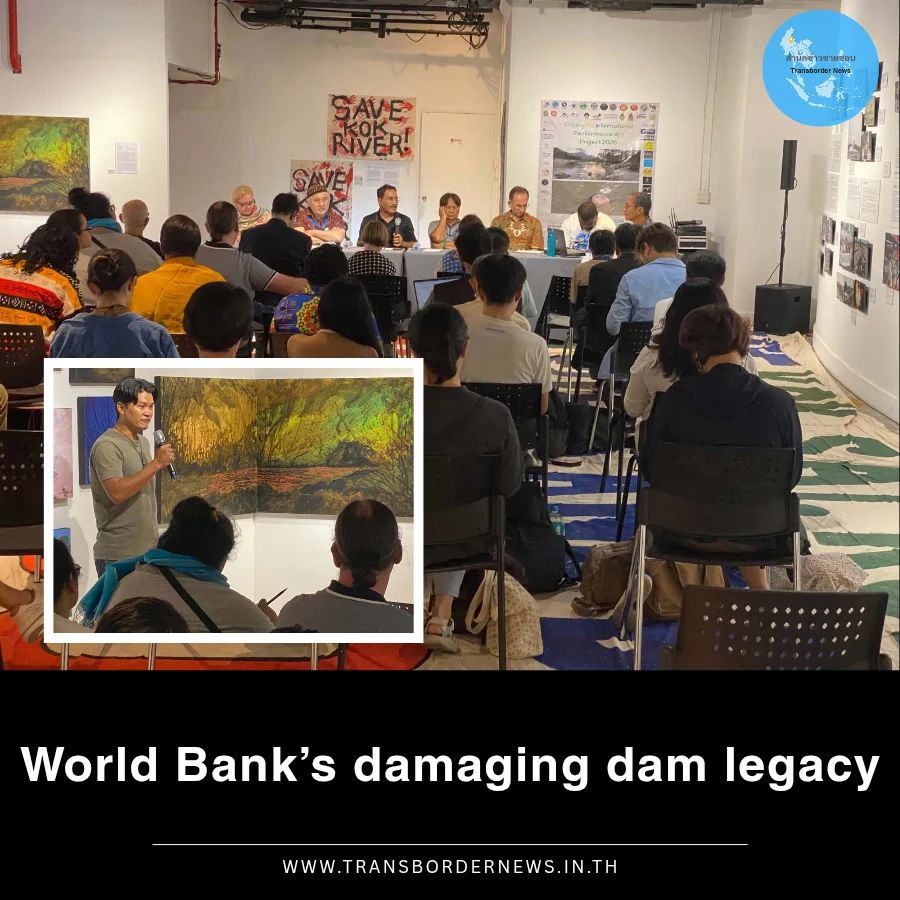
Campaigners and community representatives from several countries have criticised the World Bank’s continued support for hydropower projects, saying dams have destroyed river ecosystems and livelihoods while leaving affected communities struggling for compensation decades later.
They spoke on October 16, 2026, at the Bangkok Art and Culture Centre (BACC) during a panel titled “Broken Promises: Decades of Campaigning amid the World Bank’s Continued Financing of Hydropower Projects”. The discussion was part of the exhibition “Chiang Rai International Performance Art 2026: Resistance for Rivers”, running from October 13–25.
Sompong Wiangchan, a representative of the Assembly of the Poor’s Pak Mun dam campaign, said villagers had organised against the project from the outset, but authorities obstructed their efforts and ignored their demands.
She first travelled to Bangkok around 1990 to petition the government. Their appeals received little attention, and the coup that ousted the Chatichai Choonhavan government disrupted the movement. Villagers nevertheless continued travelling to the capital and secured talks in 1991.
Sompong said villagers also called on the World Bank to stop lending for the dam. Construction brought flooding and affected homes and farmland. About 5,000 people mobilised to demand compensation, eventually securing payments of 135,000 baht.
Rising water levels later made access to their communities difficult, prompting demands for relocation and divisions within villages, she said.
“We kept coming to Bangkok. The authorities said they would provide land for us to compensate the loss,” she said.
“In 1997, we took reporters out by boat to show them how few fish remained in the Mun River. The dam had been there since 1994, and the fish abundance had disappeared.”
A fish ladder was proposed as a remedy, she said, but villagers continued to suffer. She said a World Bank review subsequently acknowledged the dam’s failures, yet the project remained in place.
“Many governments have come and gone, but the compensation has never matched the damage caused by the dam,” Sompong said.
Iris Kashindi of CORAP in the DRC said the Inga 1 and Inga 2 dams, and plans for Inga 3 on the Congo River, had been promoted as a means of generating electricity and reducing poverty.
Communities had organised against the projects because of their severe impacts on land and livelihoods, she said. Thousands of families had been affected, with compensation still unresolved.
“The government does not understand the impacts of dams on communities. We have tried to organise and press the government, and to campaign against the dams nationally and internationally,” she said.
Hassan Jarwar, a representative of Pakistan’s Indus basin network, said World Bank-backed water and hydropower development had devastated farming and fishing communities.
He referred to negotiations in 1997 and disputes over dams and ecological damage, saying 15 tributaries had been inundated. Areas that once produced high-quality rice and supported fishing livelihoods for two million people could no longer sustain those communities, he said.
The river had become contaminated and fish stocks had declined, forcing residents to seek wage labour in cities.
Although electricity sales generated substantial revenue, he said 88% of communities had lost the natural abundance on which they depended, along with cultures closely tied to the river.
Compensation could not replace those losses, he said.
Eugene Simonov, an environmentalist from the former Soviet Union and a representative of Rivers without Boundaries, said both capitalist and communist systems had pursued large dams and water infrastructure.
In Central Asia, water diversions for rice and cotton production had contributed to the disappearance of much of a large inland sea by the early 2000s, he said. Yet similar development continued, including large dams in areas vulnerable to earthquakes.
“People’s lives have been shattered by dams, and those people are growing old,” he said.
Mr Simonov argued that only about 30% of the tens of thousands of dams worldwide remained useful, and called for an assessment of which should be dismantled.
“The issue is not only stopping more dams. It is also about responsibility for existing projects,” he said. “Instead of financing new projects, the World Bank should put money into repairing the damage.”
Philip Hirsch, emeritus professor of geography at the University of Sydney, questioned whether the World Bank had adequately responded to people affected by its projects.
He cited the bank’s support for the Nam Theun 2 dam in Laos and its report on “doing dams better”, asking what policies had actually delivered for affected communities.
Prof Hirsch said the bank worked with governments that silenced citizens and prevented open questioning, amid growing repression and authoritarianism.
Batong, a 33-year-old Indigenous representative from the Siang basin near the India–Tibet border, described mounting pressure on communities opposing a proposed megadam.
He said he had been the only member of his community able to communicate their concerns to the outside world over the previous six months. Communities had faced attacks and residents had been assaulted during the past eight months, he said.
“I do not know how the loans work. I only know that we are suffering,” he said, his voice trembling.
“There are 25,000 of us whose lives and spirits are being destroyed. Our state governor is trying to pay communities to keep quiet.”
Batong, who said he had trained as an environmental engineer, appealed for international attention to those seeking to enter his homeland and dam its free-flowing river.
“What we are facing is like genocide,” he said. “My grandfather and my father have spent 47 years fighting politicians who want to build dams.”
This is a translation of the original Thai article https://transbordernews.in.th/home/?p=48026