
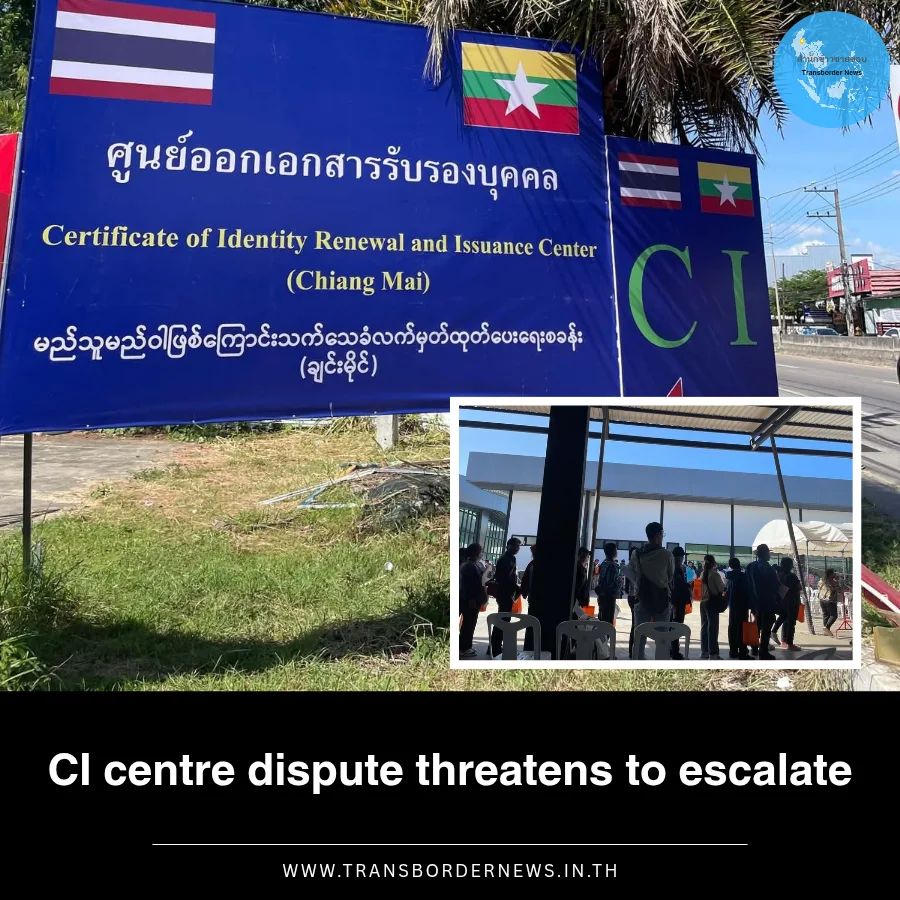
Myanmar workers are collecting signatures against Certificate of Identity (CI) centres run by Myanmar authorities in Thailand, saying the money collected is used to buy weapons to kill civilians, as an opposition MP urged the government to consider registering workers independently.
A labour rights advocate warned that the dispute could escalate and drive workers underground, leaving them vulnerable to forced labour and human trafficking.
Speaking on Oct 25, Sahassawat Kumkong, a People’s Party MP for Chon Buri, questioned Thailand’s decision to allow Myanmar officials to handle workers’ documents and tax matters at CI centres. Critics say the arrangement gives Myanmar authorities excessive scope to intervene in Thailand.
Mr Sahassawat said the central problem was Thai agencies’ emphasis on nationality verification while overlooking the costs workers face and their difficulties accessing services. The Department of Employment had also sought to evade responsibility for overseeing the centres by saying they were Myanmar authorities’ responsibility, even though they operate in Thailand under an agreement between the two governments.
He said the department’s position amounted to a clear denial of responsibility. Thai agencies had been involved in reviewing and making arrangements for the centres before they were established, and their establishment arose from an agreement between the Thai and Myanmar governments.
“If the authorities were serious about tackling this, they could do it. But if they continue to allow this to happen, it raises the question of whether they are sharing in the proceeds,” he said.
“There are two components to the rising costs at CI centres: official charges shown on receipts, which have increased from hundreds to thousands of baht, and additional booking fees workers must pay to access services.”
Mr Sahassawat said the increase in official charges could be a means of generating revenue for the Myanmar government and could amount to double taxation.
The booking fees, meanwhile, stemmed from high demand and the limited number of centres. There are currently only four CI centres nationwide, forcing workers to travel across provincial boundaries for services.
Workers in the North, for example, have to travel to Chiang Mai, while those in the Northeast, where there are no CI centres, must travel to provinces such as Chiang Mai, Chon Buri or Samut Prakan.
These limitations created opportunities to charge workers for appointments, he said. Even workers who had paid to book through the designated channels could still be asked on arrival whether they had made their appointments through a broker.
“Although the CI centres are operated by Myanmar authorities, that does not mean the Thai government has no power to oversee them. They are located in Thailand and operate under an agreement with conditions and restrictions,” he said.
“These premises are not Myanmar sovereign territory. Permission to operate here does not mean permission to do so without restrictions. Their operations are subject to the conditions agreed between the Thai and Myanmar governments.”
Mr Sahassawat said the Thai government must negotiate with Myanmar authorities to resolve the problems promptly and establish clear measures if they remained unresolved.
If the problems could not be addressed, Thailand should consider registering Myanmar migrant workers independently, instead of allowing the situation to continue on the grounds that it was Myanmar’s responsibility.
He said migration from Myanmar could no longer be treated as a normal situation, as many workers had come to Thailand to escape war in their country.
“Spain, for example, has an approach to registering people fleeing the war in Syria without relying on information from the Syrian government. Thailand also registered migrant workers independently under the Thaksin Shinawatra government and, further back, received Chinese people fleeing war,” he said.
“In circumstances like these, registration should be handled independently because this is not a normal situation. Thailand can do it and has done it before.”
If Thailand retained the CI system, Mr Sahassawat said, it must negotiate with Myanmar to ensure Thai participation in overseeing all operations, compliance with Thai law, and transparent, verifiable fees.
“I propose that all charges be fixed, receipts be issued at every stage, and access to services be simplified so workers and small employers can complete the process themselves without brokers,” he said.
“Everything must be straightforward and clear. If the announced total is 2,000 baht, it must be 2,000 baht, with no hidden charges.”
Suthasinee Kaewleklai, coordinator of the Foundation for Labour Rights, said the Myanmar workers she had spoken to were unanimous in wanting the centres run by Myanmar authorities abolished.
They would accept a system administered by Thailand, similar to the registration process for pink identification cards, she said.
Workers would reject conditions imposed by Myanmar authorities, such as demands for back taxes, because they believed the revenue was not handled transparently and was being used to buy weapons to kill civilians.
She said workers were also being required to remit money through financial institutions designated by Min Aung Hlaing’s government, effectively giving him control over their remittances.
Many workers had families living along the border, while others’ families had already fled elsewhere, leaving them no need to remit money through the channels prescribed by Myanmar authorities.
“Recently, hardly anyone has been going to the CI centre in Mahachai. Only a little over 10 workers a day are using it, compared with more than 200 on the first day. That is very low,” Ms Suthasinee said.
“Besides workers staying away, the centre itself imposes all sorts of requirements. Myanmar officials there create conditions that force workers to use brokers and pay fees at successive stages.”
She warned that large-scale protests could follow if the Thai government failed to resolve the issue, which was highly sensitive.
Several groups of Myanmar workers had begun collecting signatures against the CI system, having agreed that they would not accept the current arrangements, she said.
“If the Thai government does not find a solution quickly, many more problems will follow. I believe these Myanmar workers will not return home. They will go underground,” she said.
“Ultimately, without valid documents, they could end up in forced labour or human trafficking. They will certainly not return home because doing so would put their lives at risk or expose them to forced military recruitment. The government needs to listen to them.”
This is a translation of the original Thai article: [https://transbordernews.in.th/home/?p=48113)