
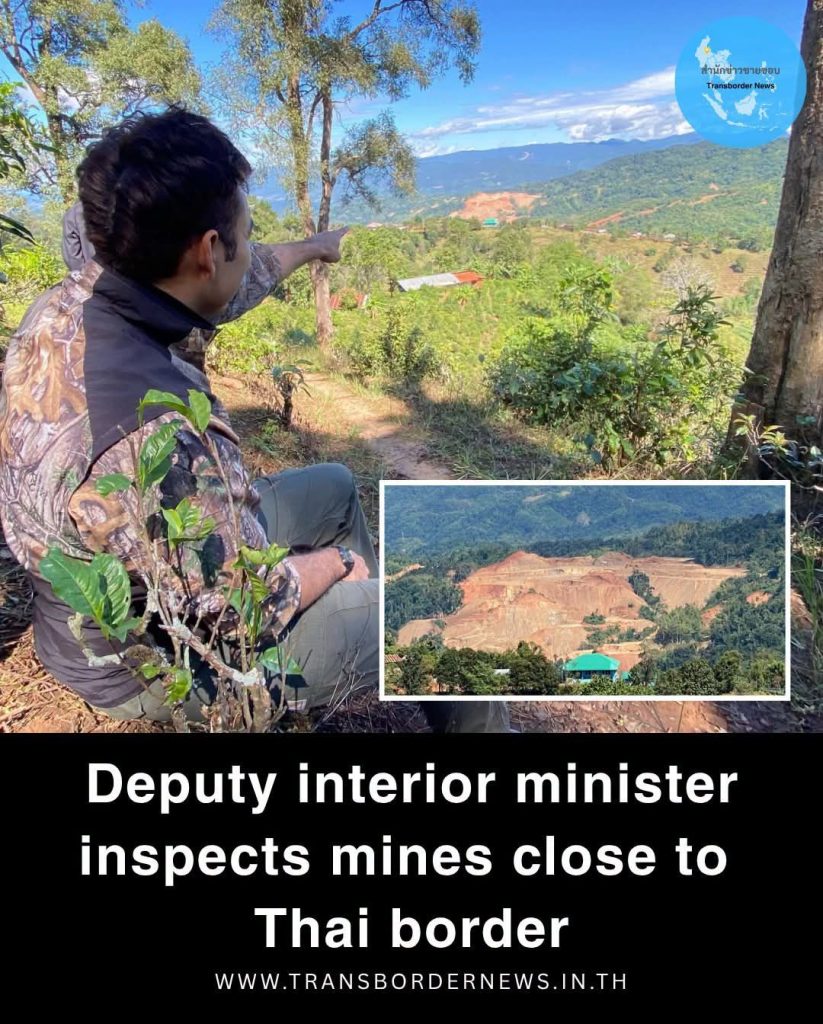
CHIANG RAI: Deputy Interior Minister J seth Thaiset visited the border on Nov 14 to inspect mining operations in southern Shan State blamed for heavy metal contamination in the Sai and Kok rivers.
A large gold mine on the Myanmar side was clearly visible from a tea plantation in Ban Phaya Phrai, Thoet Thai subdistrict, Mae Fa Luang district. Known locally as the Ban Muang Kan mine, it has extensive areas of exposed soil. Three other large gold mines operate nearby. Thai, Myanmar, Wa and Shan military bases are also located in the area.
Mr J seth said he wanted to inspect the mines’ layout after reviewing satellite images. The visit revealed extensive land clearing, with considerable room for further expansion.
He said operators appeared likely to continue expanding their mines. However, their proximity to communities and streams flowing into the Sai River posed a threat to people downstream.
Mr J seth said the prime minister had instructed him to gather as much information as possible on mineral production, importers and exporters, processing chemicals and minerals entering Thailand, including any Thai individuals or companies involved.
Prime Minister Anutin Charnvirakul had already discussed the issue with his Chinese counterpart, he said. Mr J seth was due to join the prime minister during Nov 16–18 for further talks. Countries along the affected waterways would also need to be invited to discuss the problem with Chinese authorities.
He said the situation could improve if China gave the issue due attention and honoured its commitments. However, regulating the area would be difficult because of local conflicts, while enforcing stringent international production standards would require specialists.
Asked whether Thailand could immediately restrict mineral imports from the mines, Mr J seth said the cabinet had discussed the matter, but talks with Chinese and Myanmar authorities should take place first.
Authorities needed to gather as much information as possible, assess the relevant laws and draw up measures, he said. Pressure and requests for cooperation must accompany negotiations.
“This has become a national problem. Even a 24-hour suspension of tap water production is a very serious matter. We operate to world-class standards, and if we cannot produce water, consumers will certainly be affected,” he said.
“Having seen the mining here, I believe operations could double in size within a year, given the resources, machinery and workforce available, as well as the structures already built in preparation.
“I believe mining will continue, and toxic contamination will probably increase. If operations continue, the problem will keep growing.”
Asked whether uncertainty over the border between Chiang Rai and Shan State could be raised in negotiations, given how close the mines were to Thailand, Mr J seth said the matter fell to the relevant agencies, including security authorities.
He had discussed it with the Third Army Region commander, who held confidential information that could not be disclosed. Work was continuing, he said. After the prime minister returned, the agencies would consolidate their findings and brief the public.
Asked whether mining should be halted urgently, Mr J seth said Thailand had no authority to intervene directly, despite the scale of investment and the deployment of workers and machinery.
Thailand must continue making demands and applying diplomatic pressure, he said.
He had seen far more buildings than previous reports indicated, leaving him in no doubt that further expansion was planned.
Asked whether the decision to approach China first amounted to an acknowledgement that Chinese investors owned the mines in Myanmar, Mr J seth said some minerals were exported to Thailand. However, key minerals such as rare earths and gold were not being sent to Thailand, leading him to infer that they were being shipped to China.
On Nov 15, Thongkham Inphrom, chairman of the Mae Sai district water users’ group, expressed concern about arsenic contamination in the Sai River.
Although current water test results had not reached dangerous levels, farmers feared the long-term effects of toxic substances accumulating and potentially making their rice unsaleable, he said.
“Reports of arsenic in the Sai River at 28 times the standard have caused considerable anxiety,” Mr Thongkham said.
“No buyers have yet rejected produce from Mae Sai district, as preliminary rice tests remain within safe limits. But we want government agencies to test produce before it is sold and publish the results transparently, to reassure buyers and ensure consumer safety.
“If farmers cannot sell their produce, the local economy will be severely affected.”
Aweera Phakmat, director of the Environment and Pollution Control Office 1, said tests that morning found arsenic concentrations of about 0.03 milligrammes per litre in the Sai River, above the standard of 0.01mg/l.
The Pollution Control Department was continuing to collect samples. It had conducted 23 rounds of testing in the Kok River and about eight or nine in the Sai River, he said.
Mr Aweera said the 22nd round of testing, which came to media attention in August, found arsenic concentrations of 0.28mg/l, or 28 times the standard.
Official results in September showed concentrations had fallen to about 0.02–0.03mg/l, although they remained above Thailand’s standard.
Recent tests also showed excessive turbidity. The waterworks reported levels of about 14,000 nephelometric turbidity units (NTU), around 30 times the standard.
Asked why turbidity had risen sharply within about a week, Mr Aweera said the Sai River normally recorded no more than 400 NTU. The average over almost two years of monitoring was about 400 NTU, although readings sometimes rose to 2,000–3,000, 4,000 or even 10,000 NTU.
Higher arsenic concentrations were also detected when turbidity rose to between 3,000–4,000 and 10,000 NTU, he said.
The waterworks therefore had to suspend production when turbidity was high, in line with guidance from the provincial governor.
Efforts to tackle the pollution at its source must continue alongside measures to protect downstream areas, including controls on water entering supply and irrigation systems.
On Nov 5–6, the Royal Irrigation Department stopped water entering irrigation canals because of high turbidity, to contain the spread of contamination and limit damage, he said.
Also on Nov 15, Deputy Prime Minister and Higher Education, Science, Research and Innovation Minister Yossachanan Wongsawat led a delegation to the border to inspect arsenic and heavy metal contamination in the Sai River.
The delegation brought technology developed by the National Science and Technology Development Agency (NSTDA) for practical use to provide urgent assistance to residents.
At the first Thai–Myanmar Friendship Bridge in Mae Sai district, teams from several agencies inspected high-risk sites along the river, where the water remained visibly muddy red.
Mr Yossachanan observed researchers from the National Nanotechnology Center (Nanotec), part of the NSTDA, using M-Sense, a field test kit for arsenic and heavy metal contamination.
Researchers demonstrated the kit, which is designed to be simple to operate. Its main components are a testing reagent and an electrode chip.
The chip is inserted into a reader connected to a computer with the measurement settings already configured. A water sample is mixed with the reagent and shaken, then a dropper is used to place the mixture on the chip.
Once activated through the computer, the sensor analyses the sample and displays a numerical arsenic reading within three to five minutes.
Mr Yossachanan said arsenic contamination was a regional issue to which the government attached the highest priority.
Although his ministry was not the lead agency responsible, it would provide support in addressing the cross-border crisis.
The work complemented recent bilateral talks between the Thai and Chinese prime ministers, during which the issue was raised to seek cooperation on managing and tackling pollution at its source, he said.
Academic evidence and water analysis showed that arsenic and heavy metals were often associated with suspended particles or attached to sediment carried by the current, Mr Yossachanan said.
The agencies involved were therefore studying systems to slow the flow of water or create sediment traps. Slower currents would allow contaminated sediment to settle on the riverbed, where machinery could dredge it for proper, safe disposal.
He said the approach could substantially reduce arsenic in the Sai River ecosystem.
The proposal would be submitted to the northern forward command centre for flood, storm and landslide relief for consideration and early implementation.