
By Paskorn Jumlongrach
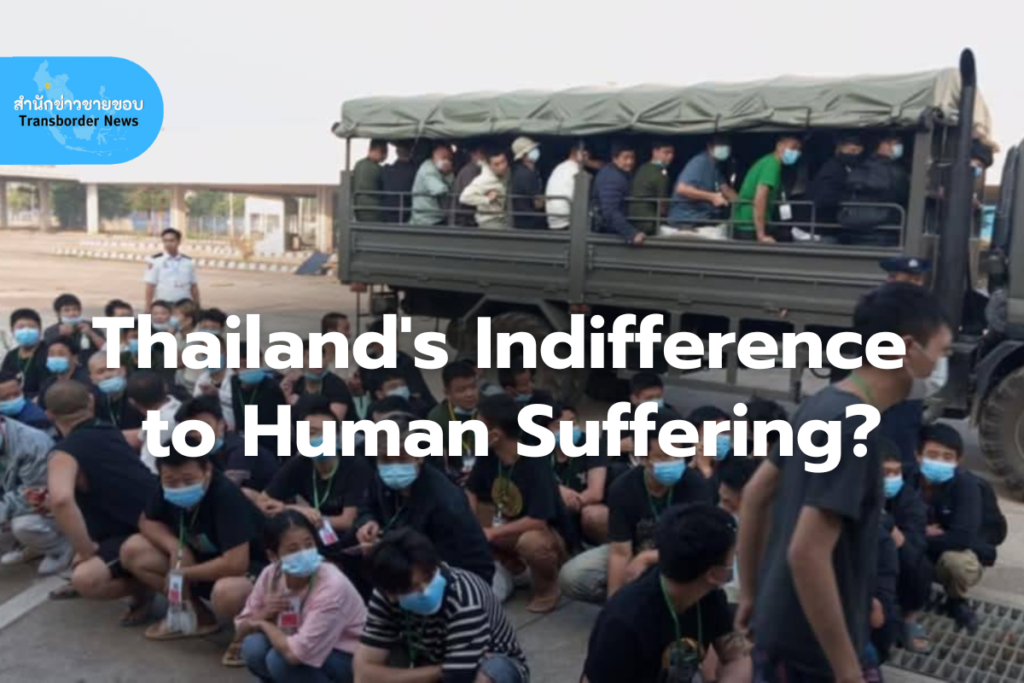
Once again, the Chinese government has sent aircraft to repatriate 1,439 of its citizens from Myawaddy, Myanmar, to Mae Sot, Thailand, before flying them home. Over three days, 19 flights transported these individuals, who had been handed over by the Karen Border Guard Force (BGF).
Just two days ago, the BGF released images of 7,000 foreigners in detention centers, their exhausted faces longing for home. Meanwhile, the Democratic Karen Buddhist Army (DKBA) escorted journalists to see over 400 foreigners housed in designated facilities. These individuals, caught in a web of human trafficking and cybercrime, are desperate to leave. The BGF and DKBA, now burdened with their care, have urged both the Thai and Myanmar governments to expedite their repatriation. However, the process remains sluggish, revealing a lack of genuine commitment.
The truth is, both the BGF and DKBA are willing to transfer more foreign nationals to Thai authorities, but the Thai government has shown little interest in assisting them from the start. The Myanmar government’s involvement appears to be more about asserting dominance over Myawaddy—an area where its influence has significantly diminished—than genuinely addressing the crisis. China and Thailand’s tacit cooperation in this situation only highlights the transactional nature of their involvement.
The Thai government continues to recycle the same narrative to justify its inaction, insisting that most foreigners caught in Myawaddy’s criminal networks are there voluntarily. This claim is not just misleading but an outright abdication of responsibility. Thai authorities—whether military, police, or diplomatic officials—have been pushing this argument since last year, even as reports of scams along the Moei River gained traction. Their dismissive attitude toward victims, many of whom were lured under false pretenses, exposes a disturbing lack of empathy.
Certain ministers, high-ranking military officers, and senior police officials have repeatedly propagated this convenient lie, despite overwhelming evidence to the contrary. Numerous testimonies from victims, documented in media reports and national referral mechanisms (NRM) archives, clearly illustrate the brutal reality of human trafficking networks. These victims were not willing participants but were deceived, imprisoned, and tortured. Yet, the Thai government refuses to acknowledge the severity of the crisis.
The government’s eagerness to tout the so-called success of its “Three Cuts” policy—aimed at disrupting criminal networks—appears more about pleasing Beijing than addressing the actual problem. While Thailand revels in China’s praise, the harsh reality remains: far more needs to be done to dismantle transnational crime syndicates operating within its borders.
The Thai government’s reluctance to aid foreign victims suffering in these criminal enclaves exposes its inhumanity. This lack of compassion was also evident in its controversial decision to deport Uyghurs back to China under dubious justifications, further underscoring the moral bankruptcy of its leadership.
As China launches its third wave of operations to retrieve its citizens—including both victims and perpetrators—Thailand remains conspicuously silent about its own nationals trapped in these syndicates. Officials know full well that a significant number of Thai individuals have been crossing into Myawaddy daily, either as scam operators or as victims themselves. A mere conversation with BGF and DKBA leaders could facilitate their rescue, yet the Thai government shows no interest in “cleaning its own house.”
Thailand’s refusal to accept large numbers of repatriated foreign victims under the pretense of being “unprepared” is an excuse that fails to hold up under scrutiny. The real reasons likely run deeper, but for now, the government hides behind a facade of plausible deniability.
The “Three Cuts” policy has done little to dismantle the entrenched system of corruption that binds Thai bureaucrats, politicians, and business elites to Chinese criminal syndicates. Reassigning a few police officers along the border is a mere drop in the ocean.
Today, thousands of foreigners remain trapped in these criminal networks, their suffering pushed further into the shadows. Meanwhile, Thai citizens continue to live in fear, dreading the next scam call that could wipe out their savings in an instant.
The Thai government’s so-called crackdown is nothing more than a flickering matchstick—offering a brief illusion of action but ultimately destined to be snuffed out unless genuine reform takes place.
This is a translation of original Thai article https://transbordernews.in.th/home/?p=41649