
By Paskorn Jumlomgrach
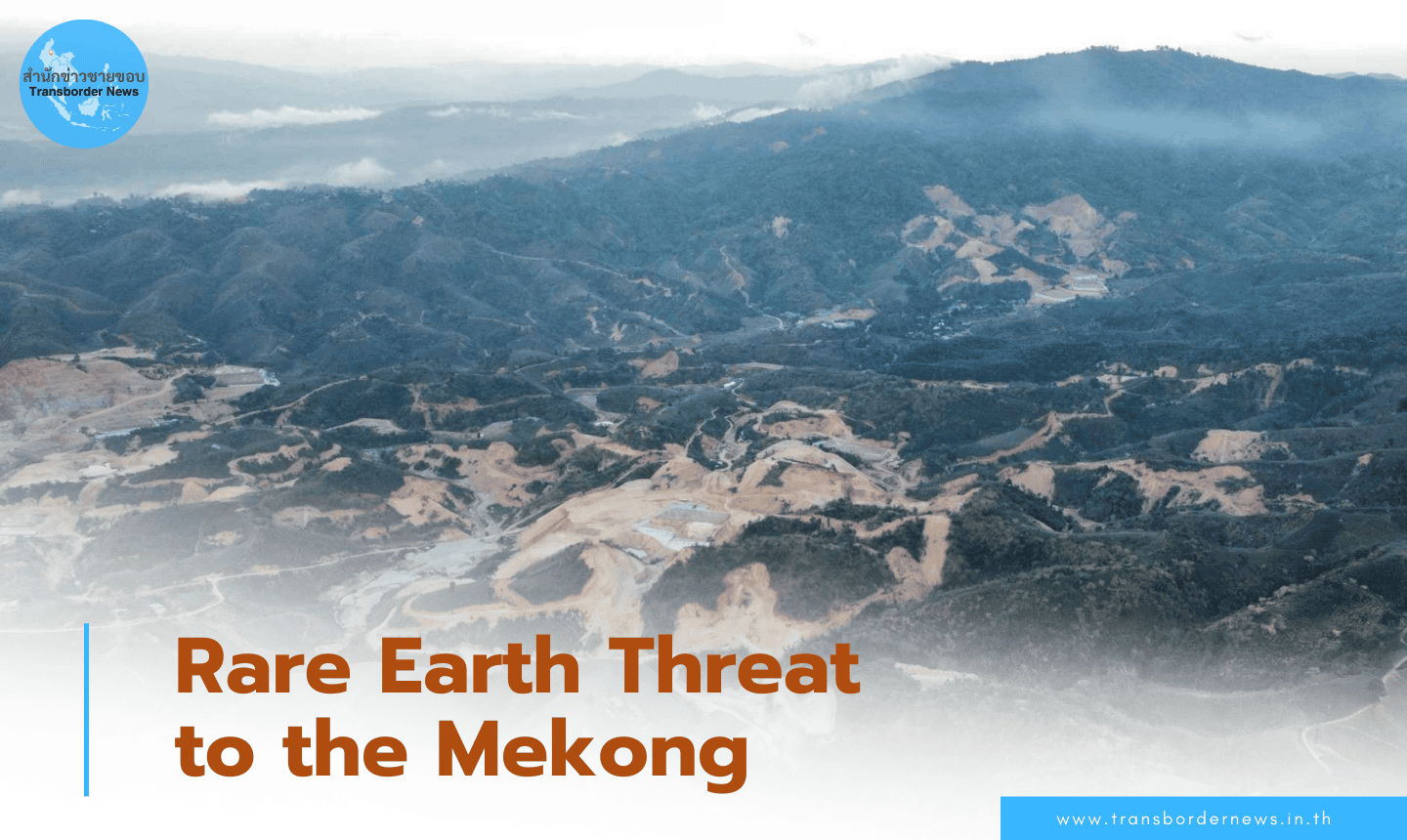
Satellite imagery cited by the Shan Human Rights Foundation (SHRF) in a recent statement, together with findings from the U.S.-based think tank Stimson Center released just last month, point to the same alarming reality: a massive concentration of rare earth mining sites is emerging across Southeast Asia, particularly in Myanmar and Laos.
In Kachin State, northern Myanmar, more than 300 rare earth mines now scar the mountain ranges that serve as critical watersheds. The environmental devastation in Kachin has already reached severe levels. Although most of these mines are now under the control of the Kachin Independence Army (KIA)—an armed group resisting the Myanmar military regime—the extraction continues unabated. For the KIA, revenue from rare earth is a lifeline, fueling their armed struggle. Yet, unlike the junta, the KIA has shown some responsiveness to local voices: providing compensation for affected villagers and allowing researchers to access mining sites.
All of Kachin’s rare earth ore flows directly into China. Despite Beijing supplying weapons to Myanmar’s military regime and pressuring ethnic armed groups to cease fighting, China shows no hesitation in importing rare earth extracted from territories controlled by anti-junta forces.
What should most alarm the Mekong region, however, is the discovery of extensive rare earth mining near the river’s headwaters. In Mong Bawk, a town just south of the Wa Special Region in eastern Shan State near the Chinese border, 25–30 mining sites have been identified. These operations sit between the Loi River, which drains into the Mekong, and the Kha River, which flows into the Salween. The risk of heavy metal contamination spreading into both great international rivers is immense.
Another hotspot is Mong Yaw, also in eastern Shan State, where at least 19 rare earth mines have been documented within just 40 kilometers of the Mekong. Additional mines have been found at the headwaters of the Kok and Sai rivers—both tributaries of the Mekong—as well as scattered across northern and central Laos.
The Mekong, the “mother river” of mainland Southeast Asia, now faces perhaps the gravest ecological crisis in its history—far more destructive than hydropower dams or even the Mekong rapids blasting. While dams and rapids blasting alter the river’s flow and ecosystem, water still runs. But heavy metal poisoning is different: it slowly kills every living thing. The river itself too. Once the Mekong’s waters can no longer be consumed or used, tens of millions of people face disaster.
The warning signs are already visible. In July 2025, the Mekong River Commission (MRC) reported dangerous levels of heavy metals between the Golden Triangle and Thai-Lao border in Chiang Khong, Chiang Rai. Thailand’s Pollution Control Department also confirmed unsafe arsenic levels in Chiang Saen. These findings are a clear signal that toxic runoff from upstream mines is already seeping into the Lower Mekong.
Most of these mines are illegal, run under the protection of armed ethnic groups that grant Chinese mining companies access. Heavy metals from rare earth and gold mines in the Kok and Sai river headwaters in Shan State have already flowed downstream, affecting millions of people and putting pressure on the Thai government to confront the issue. Discussions have even taken place with Chinese representatives, as evidence suggests the mines are Chinese-owned. But Chinese officials have repeatedly denied this, insisting these are not Chinese businesses—answers that only raise further questions.
Local Shan villagers living near the Kok River headwaters tell a different story. They see only Chinese workers running the mines, with Wa soldiers enforcing strict security to keep outsiders away. These villagers have been hired to escort survey teams to new mine sites along the Kok. They add that obtaining Myanmar ID cards is easy for Chinese nationals: a bribe to local officials is enough. So on paper, these are not “Chinese businesses.” But in reality, the operations are Chinese.
What Beijing never addresses is whether it tracks the true origins of the rare earth it imports from Myanmar. China enforces some of the world’s strictest environmental regulations within its own borders. Yet it allows Chinese actors with little moral or humanitarian restraint to pillage neighboring lands for profit.
No community, no nation, wants “sons of heaven” without ethics.
——————
Paskorn is founding editor of non-profit independent news outlet based in Thailand www.transbordernews.in.th
This is an original version of an op-ed published on the Bangkok Post https://www.bangkokpost.com/…/rare-earth-and-the-risk…