
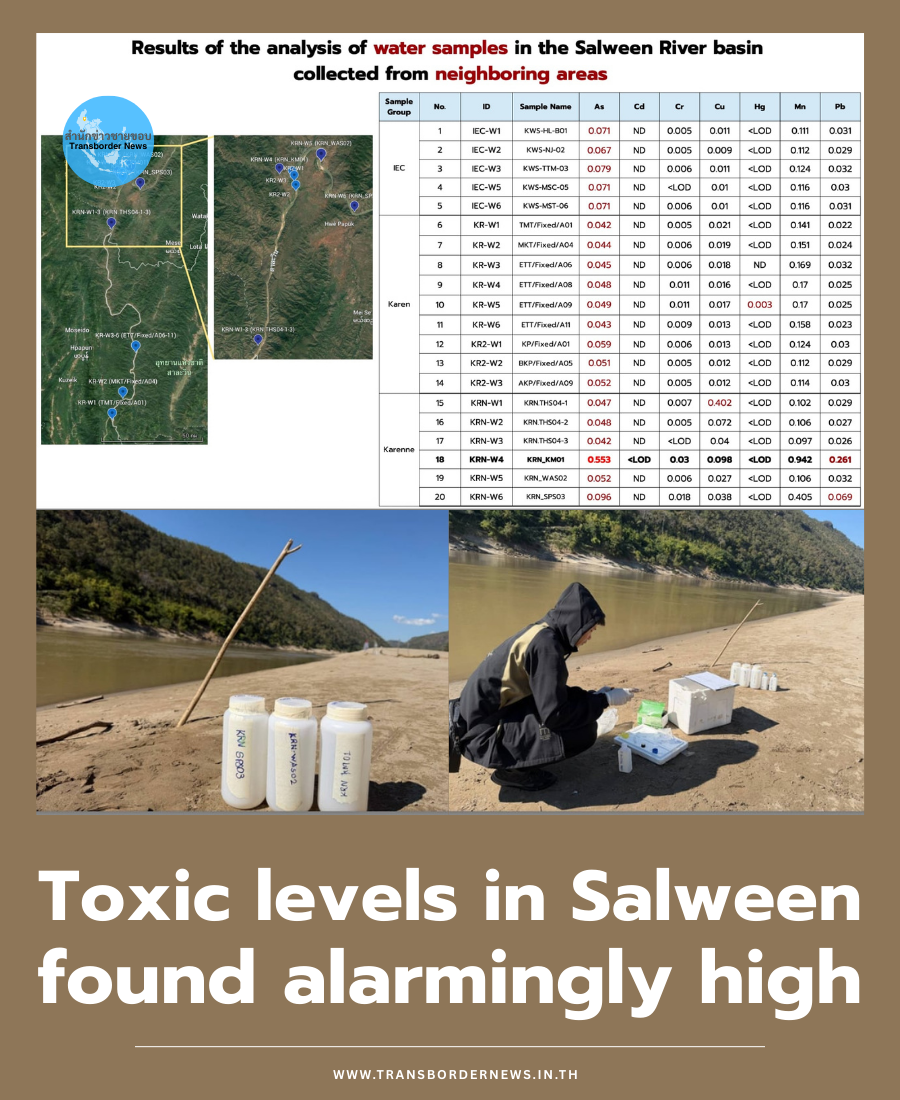
At a press conference held on Feb 10, 2026, in Chiang Mai, the Interim Executive Council (IEC) of Karenni State, led by spokesman Banya Kung Aung, joined Asst Prof Dr Wan Wiriya of the Faculty of Science, Chiang Mai University, and Asst Prof Dr Surachanee Sriyai, co-founder of S&I Strategic Advisory, to present the findings of a joint water-quality assessment of the Salween River.
Dr Wan said field teams collected water and plant samples along the Salween in December 2025. Sediment deposited along the riverbanks during flooding in 2024 was found to be clay-rich, with significantly higher toxic residues than sandy soils typically seen along the river.
“Vegetation grown along the Salween and brought in for testing showed contamination. Whether residues exceed standards depends on the plant species,” he said. “Aquatic plants eaten by fish, such as krai grass, were also contaminated. Crops grown on sandy soils along the banks showed lower levels than those planted close to the water.”
Local residents told researchers the clay sediment arrived during 2024 floods, as the Salween’s banks are usually sandy. “The clay indicates sediment transported from elsewhere. We do not know its origin,” he added.
Dr Wan voiced concern that further flooding could re-mobilise contaminants, noting that the latest concentrations measured in the Salween were comparable to levels recorded in the Sai River, a Mekong tributary, in Mae Sai district of Chiang Rai prior to recent flood surges.
“I am worried that if another flood occurs and large volumes of chemicals are used in mining, contamination could return,” he said.
Dr Surachanee said any discussion of river contamination inevitably raises the role of China, which benefits economically while being upstream of many affected areas.
“At present, China gains the benefits while downstream countries bear the pollution. There is little incentive for change,” she said. “The question is whether Thailand and other affected countries can work together to engage China constructively on this issue.”
She suggested that dialogue might also involve ethnic authorities along Thailand’s border, including Karenni and Karen groups along the Salween and Shan State actors along rivers such as the Sai, Kok, Ruak and Mekong. However, she acknowledged these groups are not representatives of Myanmar’s central government, raising diplomatic complexities for Thailand.
Calling for an outright closure of mines may be unrealistic, she added, noting that gold, rare earth and tungsten mining have long provided revenue for ethnic armed groups engaged in conflict with Myanmar’s military. “The challenge is how to ensure mining does not cause excessive environmental damage, and what viable alternatives exist,” she said.
Mr Banya said the Salween is not solely Karenni’s river, as it flows from China, making unilateral solutions impossible.
“We ask the Thai government to cooperate with us to reduce toxic contamination. Beyond the Salween, there are also dam-related concerns,” he said. He called for technical support, equipment for water sampling and greater financial assistance, suggesting cooperation through Thai universities or civil society organisations.
Mining in Karenni State has taken place for more than a century, he said, previously without major problems due to effective wastewater treatment systems.
“We are trying to return to earlier systems that worked well. But current demand is extremely high, pushing the use of chemicals. We cannot solve this alone. We also need to produce and sell minerals to sustain ourselves,” he said.
According to the research team’s laboratory analysis at Chiang Mai University, arsenic levels (As) in the Salween and its mining-affected tributary ranged from 0.042 to 0.553 milligrams per litre, or four to 55 times above standard limits. The highest concentration — 0.553 mg/l — was detected in water sampled from an old mining site in Karenni State. A sample taken from the Salween upstream of the Thai border at Pha Daeng in Mae Sariang district of Mae Hong Son recorded 0.047 mg/l.
Previous reports have also documented rapid expansion of rare earth mining in areas under the control of the United Wa State Army at the headwaters of the Salween’s tributary in Shan State, near the Chinese border. At least 26 rare earth mining sites have been identified in the area, with environmental impacts reported to be mounting.
This is a translation of original Thai article https://transbordernews.in.th/home/?p=45117
transbordernews.in.th