
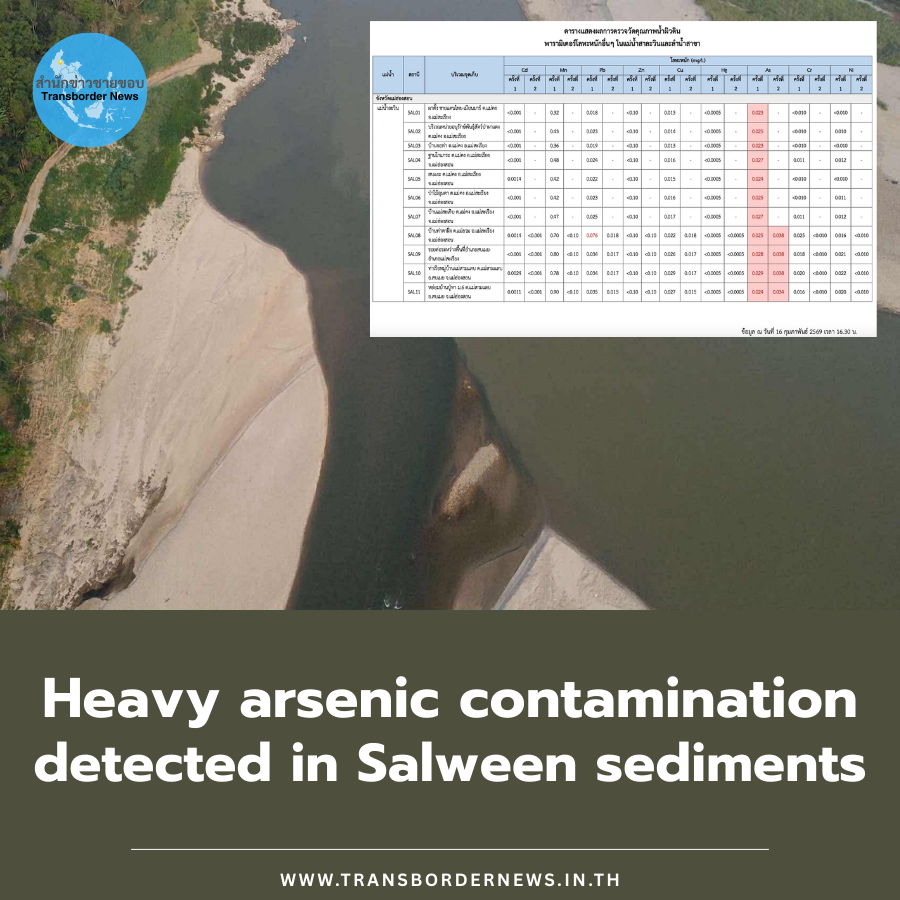
The Pollution Control Department (PCD) in Chiang Mai has reported that sediments in the Salween River contain arsenic levels high enough to pose a severe risk to bottom-dwelling organisms, raising concerns about potential impacts on the aquatic food chain.
According to a report published on March 1, the Pollution Control Department released the second round of monitoring results on water quality in the Salween River and its tributaries following earlier findings of contamination exceeding environmental standards.
Environmental sampling was conducted along the Salween River on the Thai-Myanmar border, from Ban Tha Ta Fang in Mae Sariang district to Ban Sob Moei in Sob Moei district, Mae Hong Son province, as well as in several tributaries including the Moei River, Yuam River and Pai River.
Pollution Control Department (PCD) has set a monitoring plan for the Salween and its tributaries from November 2025 to September 2026, with testing conducted every two months.
Results from the second survey conducted between Jan 26 and Jan 30, 2026, found that water turbidity had decreased significantly compared with the first round. Earlier measurements recorded turbidity levels between 391 and 1,477 NTU, while the second round showed values between 42.7 and 53.9 NTU.
However, arsenic concentrations exceeded the standard at all monitoring sites along the Salween River, ranging from 0.034 to 0.038 milligrams per litre. Water quality in the tributaries, by contrast, remained within regulatory limits.
Sediment analysis from the second round revealed arsenic concentrations exceeding the threshold classified as “severely hazardous to benthic organisms” at all sampling points from Ban Tha Ta Fang to Ban Sob Moei, with levels ranging from 36 to 75 milligrams per kilogram.
Pollution Control Department noted that the sediment quality guideline for surface water bodies defines a “severely hazardous” level for benthic organisms.
Such contamination can accumulate in fish, and if consumed frequently by local residents may pose health risks. Potential symptoms of chronic arsenic exposure include numbness in the hands and feet, skin darkening and thickening, and irregular heart rhythms.
Benthic organisms — animals that live and feed in riverbed sediments — are mostly invertebrates such as aquatic worms, small crustaceans and snails, which form an important part of the aquatic food chain.
Dr Wan Wiriya, deputy head of the Environmental Science Research Center and a lecturer in the Department of Chemistry at Chiang Mai University, said the findings were broadly consistent with earlier tests conducted by the university.
“What is unusual this time is that heavy metal levels typically increase with turbidity — the murkier the water, the higher the metal concentrations. But in the Salween this time, the water appears much clearer compared with previous tests, yet arsenic concentrations are higher,” he said.
“This raises questions about whether the arsenic is present not in suspended sediments but possibly in dissolved form.”
Dr Wan said other factors could also explain the higher concentrations, including lower river flow during the dry season, which can increase pollutant concentration.
“We still do not know whether the arsenic originates from suspended particles, sediment or dissolved forms,” he said. “Nor do we know if unusual activities are taking place along the river, or whether water levels have dropped significantly.”
He added that the Salween basin involves multiple factors and remains a cause for concern.
“In my view, the Salween is the most worrying, followed by the Mekong, then the Sai River and the Kok River,” he said.
He suggested that mining activities along tributaries of the Salween may be contributing to contamination, though clear data remains limited. According to information from the Interim Executive Council (IEC) of Karenni State, existing mining operations in the area have reportedly shifted to using more chemical processing methods.
Dr Wan also warned that the high arsenic levels found in sediments indicate significant accumulation of heavy metals in the river system.
“This contamination is effectively dormant and could be released at any time, particularly during high-flow periods when sediments are stirred up and carried downstream,” he said.
He has asked Mae Sam Laep local administrative officials to collect Salween River snail samples for laboratory testing, noting that local residents commonly consume freshwater snails during the dry season.
This is a translation of original Thai news article https://transbordernews.in.th/home/?p=45274
transbordernews.in.th