
By Paskorn Jumlongrach
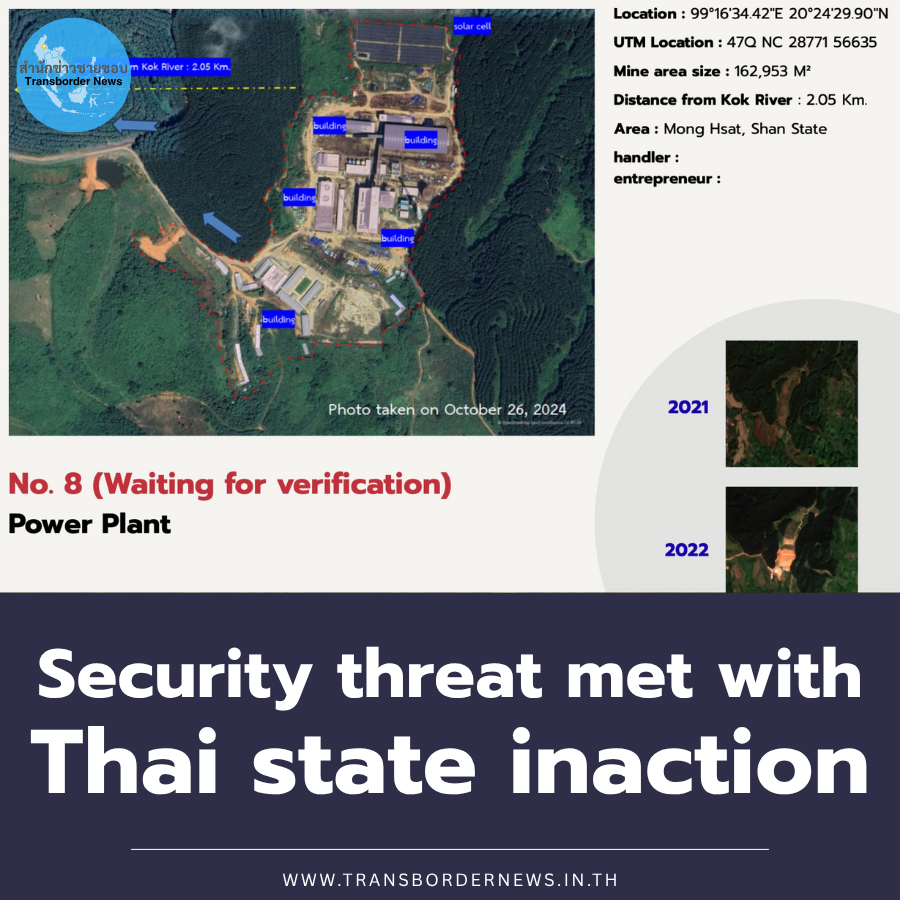
A report released on March 22, 2026 by the Shan Human Rights Foundation revealed that the United Wa State Army has constructed a coal-fired power plant in southern Mong Hsat, Shan State, near the headwaters of the Kok River, just 19 kilometres from Thailand’s Mae Fah Luang district in Chiang Rai.
The plant is compounding an already worsening toxic water crisis in the Kok and Sai rivers, which is affecting communities in Chiang Mai’s Mae Ai district and across Chiang Rai. More critically, it further diminishes prospects for restoring rivers already contaminated by upstream pollution.
For more than three decades, the UWSA has posed a significant security challenge to Thailand. Beyond its links to transnational crime — including narcotics, scam operations and illegal mining — the group has also, according to long-standing concerns, embedded itself within Thailand’s power structures through systematic and well-planned strategies.
With vast financial resources derived from illicit activities, the network is alleged to have bribed officials to facilitate Thai citizenship for Wa individuals, often at the expense of long-marginalised ethnic communities still awaiting legal recognition. Such concerns have circulated widely among practitioners working on citizenship and ethnic rights issues.
The Wa network has also reportedly expanded its influence into Thailand’s political system, fielding candidates in local elections and gradually ascending the political ladder. Observers warn that this trajectory now appears to be reaching higher levels of power.
The key question is whether Thailand’s security agencies are aware of this trend, and if so, why it has been allowed to persist. The answer, many argue, lies in entrenched corruption, which has weakened state mechanisms — particularly within the military and police — leaving the public to bear the consequences.
Evidence suggests that authorities have long been aware of developments along the border. The coal-fired power plant in Mong Hsat, for instance, had reportedly been documented in Thai military intelligence for nearly two years, alongside information on rare earth and gold mining operations near the Kok and Sai river sources.
A series of reports published by Transborder News in September last year, based on data from agencies under the Defence Ministry, indicated that mining activities and the construction of a coal plant near Mong Hsat were already underway at that time.
Despite this, no decisive action has been taken. The situation has been allowed to deteriorate, even as authorities were aware that such developments could intensify transboundary pollution and generate broader security risks. The plant is now operational, and pollution impacts are reportedly increasing. Local residents believe the consequences will soon reach Thai territory.
Communities along the northern border provinces of Chiang Rai, Chiang Mai and Mae Hong Son are increasingly vulnerable, facing what has been described as a “silent encroachment” by Wa forces. Since the tenure of former army chief Surayud Chulanont, there has been little evidence of proactive Thai policy to counterbalance Wa influence.
In reality, Thai authorities possess extensive information about the situation along the border areas adjacent to Wa-controlled territories and the Myanmar military. What appears lacking is decisive policy action to safeguard Thai national sovereignty and citizens.
Claims that the Myanmar state is unable to act because these areas fall under Wa control are widely viewed as insufficient. Along much of the northern border, Wa and Myanmar military bases are interspersed along the ridge lines, visible even from the Thai side.
Meanwhile, a large gold mine near the Sai River headwaters, opposite Mae Fah Luang district, is reportedly operated by Myanmar military-linked actors. The site, visible from Thai territory and located near Thai military positions, has been linked to recurring mudflows and flooding in Mae Sai. It raises questions about how such activities could proceed without the knowledge of Thai authorities.
This leads to a deeper concern: what factors are effectively silencing or blinding state mechanisms to the root causes of pollution and environmental disasters affecting downstream communities?
The prime minister or defence minister should establish an independent inquiry to investigate these issues. If left unchecked, there are fears that Thailand’s sovereignty could gradually erode without public awareness.
The UWSA’s growing confidence stems from its expanding influence in Myanmar, both politically and militarily, with backing from the Myanmar junta and China. This has enabled increasingly assertive actions that exploit vulnerabilities within Thailand’s governance systems, particularly corruption.
Unregulated rare earth and gold mining continues unabated in southern Shan State near the Thai border, despite mounting downstream impacts. At the same time, the coal-fired power plant operates around the clock, underscoring what critics see as a lack of regard for Thai authorities.
Thai citizens are left to shoulder the burden — from narcotics to transboundary pollution — while facing potential territorial encroachment. Yet Thailand’s foreign affairs and security responses remain reactive and insufficient.
The scale and complexity of the situation raise serious questions about whether the current government fully understands or can effectively address the challenge. For affected communities, the hardship appears far from over.
This is a translation of original Thai article https://transbordernews.in.th/home/?p=45545
transbordernews.in.th