
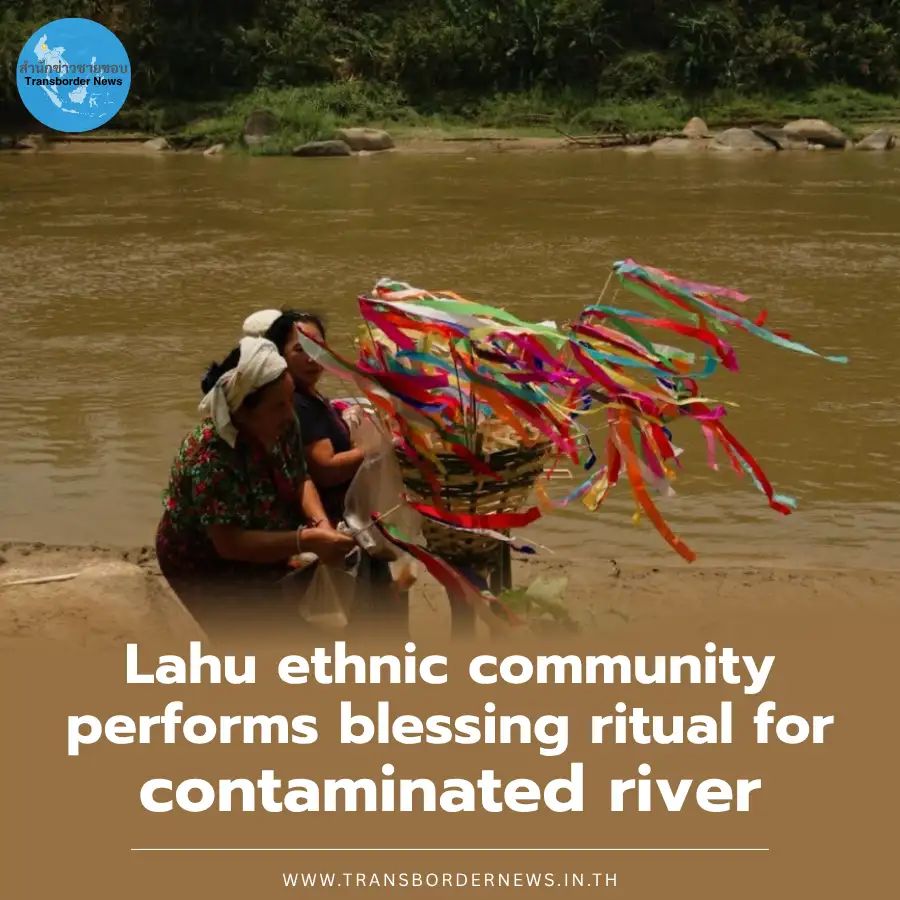
CHIANG RAI — Members of the Lahu ethnic community in Ban Pha Moob gathered along the Kok River on April 8, 2026, to perform a traditional ritual to renew the river’s spiritual life and seek forgiveness from nature, as concerns grow over environmental degradation and pollution linked to upstream mining.
The ceremony, known as Sala Tawe, was held on the riverbank in Mae Yao subdistrict, Muang district, ahead of the planting season. Villagers set up offerings at six points and tied coloured cloth in four directions, with two additional sacred spots located by the river and beneath a large tree. These symbolised respect for the spirits of the forest and mountains, as well as the river goddess, seeking blessings for fertile crops, community safety, and permission to use natural resources.
Before the ritual began, each household contributed food to a communal meal, with families sharing large pots of rice in a practice passed down for more than 200 years.
Mr Yakai, a Lahu villager from Ban Pha Moob, said the community’s way of life has long been tied to the Kok River, particularly fishing.
“In the past, we fished almost every day. When the water was low, we cast nets; when it rose, we set traps,” he said. “But after the floods and landslides about two years ago, the river has remained murky ever since. Now there are concerns about toxic contamination, so people have stopped fishing altogether. We don’t even dare use the water for washing clothes or watering vegetables.”
A community leader and assistant village headman of Moo 12 said the ritual reflects a deep-rooted belief system connected to the river, aimed at protecting children who play in the water and villagers who rely on fishing.
“In the past, the river would be lively during preparations for the ceremony. Children swam freely, and people could cross to both sides because the water was clean. Today, the atmosphere has completely changed,” Mr Yakai said.
The assistant headman added that the ritual is closely tied to agriculture, which remains central to the community’s livelihood. In the past, villagers practised rotational farming across the পাহাড়? remove foreign -> mountains, but this ended about 20 years ago following the declaration of forest reserve areas, despite the community’s long-standing presence. Today, residents have adapted by cultivating rice, maize and pineapples on their own land.
Mr Jaki Jato, the village’s spiritual leader, said April marks the period before planting and the start of seasonal livelihoods. A propitious day is selected, known as the “Hawk Day” — named after a squirrel-like animal — considered auspicious in Lahu tradition.
“At the forest spirit site, we ask for safety for those who once hunted and for success in farming,” he explained.
Mr Jafoo, a member of the Mae Yao tambon municipal council and a Ban Pha Moob resident, said the ritual is not only about seeking good harvests but also about expressing gratitude to the guardian spirits that have protected the village throughout the year.
“In the past, we did not practise Buddhism but followed animist beliefs. Even today, although many of us are Buddhist, we continue to respect the spirits of the forest and the river. This belief has been preserved across generations,” he said.
Mr Jafoo added that the Kok River is the lifeblood of riverside communities, not only for this village but for people across the entire basin.
“If the mining upstream could be stopped, it would be for the better. We do not want things to continue like this. It feels as though a part of our lives has already been destroyed,” he said.
This is a translation of original Thai article https://transbordernews.in.th/home/?p=45700