
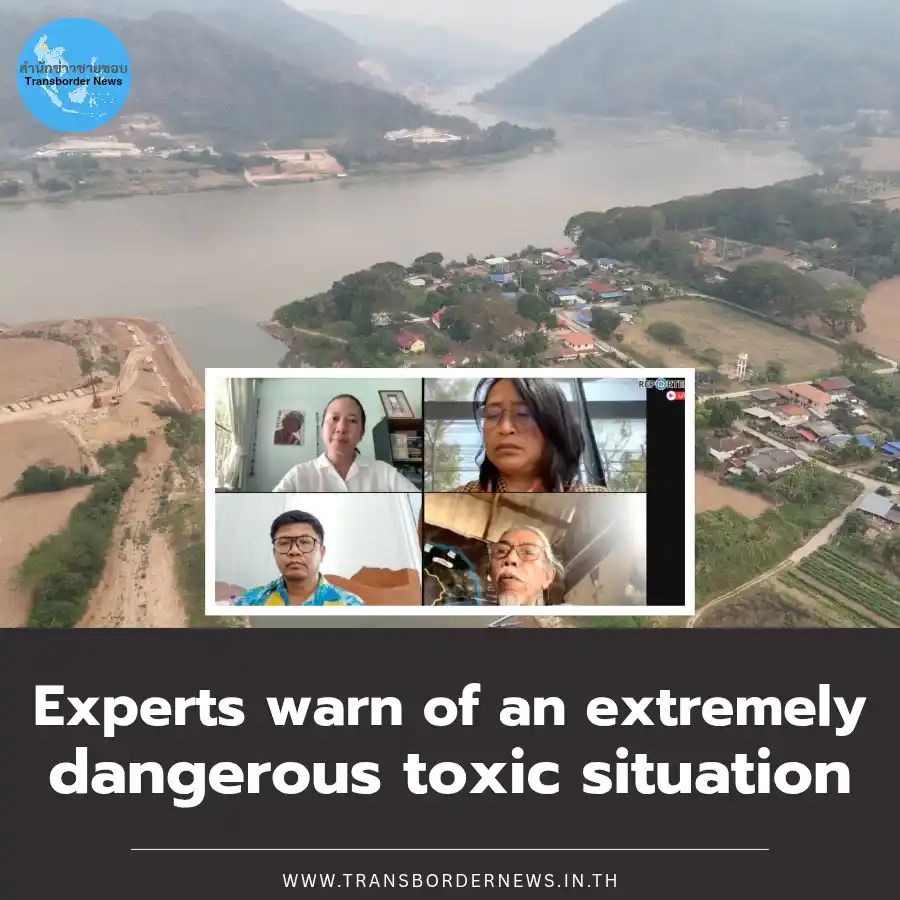
Arsenic concentrations in Mekong River sediment have reached levels comparable to those found at active mining sites, experts have warned, calling on the public to avoid consuming fish and benthic organisms amid growing evidence of contamination entering the food chain.
At an online forum titled “Crisis of Contamination in the Mekong River” held on April 15, 2026 by The Reporters and Transborder News, researchers and environmental advocates raised alarm following recent findings by the Office of Environment and Pollution Control Region 1. Sediment samples collected on April 11 from the Kok, Sai, Ruak and Mekong rivers revealed heavy metal contamination exceeding safety standards across all waterways.
In the Mekong, arsenic levels were recorded as high as 296 milligrams per kilogram, nearly nine times above the threshold of 33 mg/kg considered severely hazardous to benthic organisms.
Assoc Prof Dr Wan Wiriya of the Chemistry Department, Faculty of Science at Chiang Mai University, said long-term monitoring has identified the Golden Triangle area as the most contaminated stretch of the Mekong. The latest reading of 296 mg/kg marked a sharp increase from 110 mg/kg recorded in the previous round.
Although humans may not come into direct contact with riverbed sediment in the same way as bottom-dwelling organisms, arsenic can accumulate in ecosystems and be transmitted through the food chain, eventually reaching humans, he said.
“Researchers have detected heavy metals in freshwater algae, known locally as kai, at levels of around 24 mg/kg,” Dr Wan said. “This indicates that contamination has already spread to aquatic life. In fish, heavy metals have been found accumulating particularly in internal organs and abdominal areas.”
He advised the public to avoid or temporarily suspend consumption of aquatic species from affected rivers, and to minimise contact with organisms from high-risk areas to reduce health risks.
Dr Wan called for a collaborative response involving academia, civil society and relevant authorities, as well as cross-border cooperation with areas in Kachin and Shan states to build shared awareness of the severity of the problem. However, he noted that long-term solutions require state-level engagement, which has yet to show clear progress.
He also urged authorities to communicate transparently with the public and to issue timely warnings, rather than waiting for impacts to escalate. “The contamination levels recorded here exceed even some mining areas overseas, which typically range between 180 and 200 mg/kg,” he said.
Niwat Roykaew, chairman of the Chiang Khong Conservation Group, warned that without clear and concrete measures, the crisis could escalate into a “disaster” for the Mekong subregion, affecting both river ecosystems and local livelihoods.
He said a key challenge has been the lack of decisive action, with authorities focusing on whether contamination levels exceed standards, despite clear evidence that pollution is already present and increasing.
Since late January, civil society groups, academics and local agencies in Chiang Khong district, along with local hospitals, have conducted independent sampling in areas not fully covered by state monitoring. Tests found arsenic levels in soil at a vegetable plot as high as 29.87 mg/kg, along with contamination in crops such as bean sprouts and household vegetables. Arsenic was also detected in unhusked rice and large river prawns at levels exceeding safety standards, indicating that risks have spread into the food chain.
Niwat added that some officials have been reluctant to disclose information due to pressure and fear of repercussions, leading to the issue being downplayed. He called on the government to declare the affected areas a disaster zone, implement health and food safety surveillance in all communities, and pursue solutions at the subregional level, given the issue’s implications for national security.
Pianporn (Pai) Deetes of the Rivers and Rights Foundation and secretary-general of the Hill Area and Community Development Foundation said the latest sediment survey confirmed widespread heavy metal contamination, particularly arsenic, in the Kok, Ruak and Mekong rivers. Several locations were classified as “red zones”, indicating arsenic levels above 33 mg/kg and posing severe risks to benthic organisms.
The highest concentration was recorded at the Mekong’s Golden Triangle border crossing in Chiang Saen district, highlighting escalating environmental risks, especially along the Thai–Lao border.
Citing data from the Stimson Center, a US-based policy research institute, Pianporn said satellite analysis shows the number of unregulated mining-related activity sites in the region increased from around 2,400 to over 2,500 within just a couple of months. More than 800 unregulated mining sites have been identified in the Mekong basi