
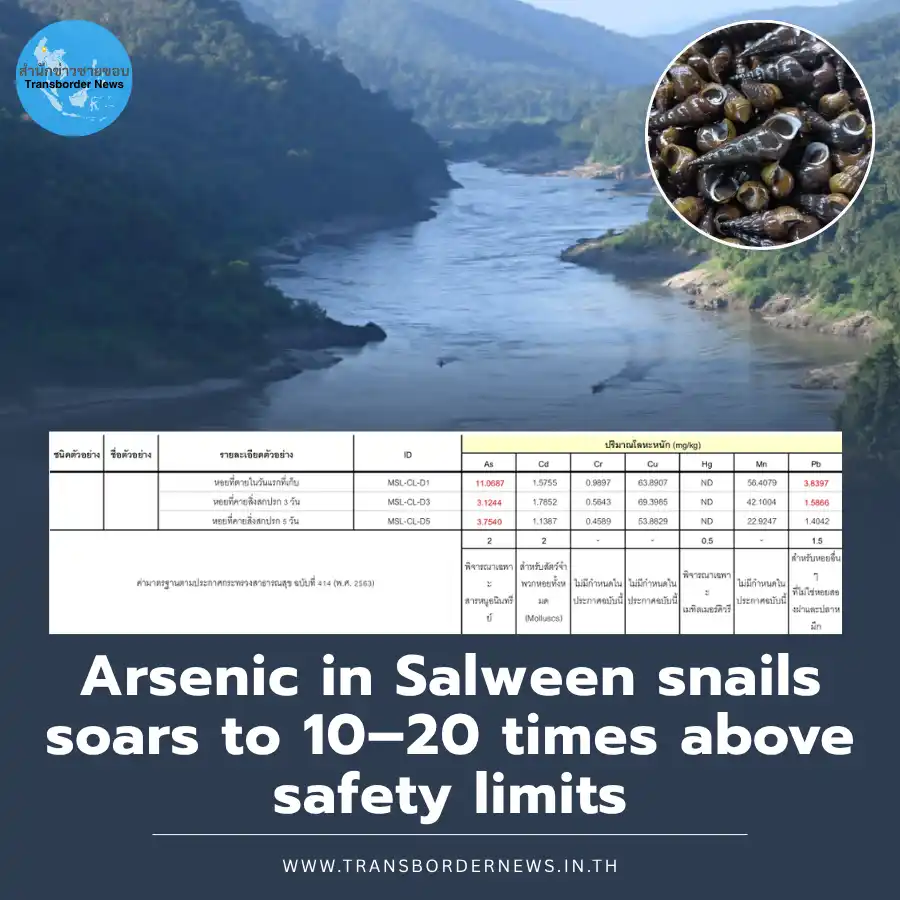
MAE HONG SON — Snails collected from the Salween River have been found to contain arsenic at levels 10 to 20 times above safety standards, prompting experts to warn of potential acute toxicity and urge the public to avoid consumption.
Somporn Pengkham, director of the CHIA Platform and head of a research project on strengthening environmental health literacy through citizen science, revealed the findings on May 3 2026. The study is supported by the Health Systems Research Institute (HSRI).
Samples were submitted by the Mae Sam Laep Subdistrict Administrative Organisation in Sob Moei district and analysed at the Environmental Science Research Centre of Chiang Mai University. Laboratory results showed arsenic and lead contamination exceeding standard limits. Cadmium levels remained within acceptable thresholds, while chromium, copper and manganese were detected but lack official reference standards under the Public Health Ministry. Mercury was not detected.
Mr Somporn said arsenic and mercury are among the most hazardous pollutants due to their high toxicity and long-term health impacts. In response, the research team has outlined a series of measures.
Local authorities and community monitoring teams along the Salween have been informed and asked to communicate risks to residents. Villagers are advised to temporarily avoid consuming river snails, particularly vulnerable groups such as children, pregnant women, the elderly, and those with underlying health conditions including kidney disease and cancer.
Further sampling is planned to test for inorganic arsenic, the most toxic form. Researchers will also work with local monitoring teams to design health risk screening tools tailored to the Salween context.
The screening aims to identify high-risk individuals, whose data will be used to coordinate with local health services for laboratory testing, including urine tests for arsenic and blood tests for lead. If contamination is found in residents, appropriate medical care and preventive measures will be introduced to reduce long-term health risks.
“This process is part of a broader effort to build community-based environmental and health monitoring systems,” Mr Somporn said. “It aims to equip communities with knowledge, access to information, and the ability to analyse risks and make informed decisions to protect themselves.”
Dr Kwanpracha Chiangchaiskulthai, a senior medical expert at the Ministry of Public Health, said the findings were consistent with earlier detections of heavy metals in Salween River water.
“It is not surprising that aquatic species contain contaminants. This is how the food chain works,” he said. “When people consume contaminated snails or fish, especially predatory and bottom-dwelling species, they are also exposed to these toxins.”
He added that previous tests had found heavy metals concentrated in fish heads and internal organs, though assessments had often been conducted separately.
“We need to monitor human exposure more closely. If contamination is detected, support must be provided, and surveillance must continue,” he said. “The Public Health Ministry should strengthen monitoring systems and inspect food sold in markets. We need to be more alert.”
Dr Kwanpracha also called for an official public warning, noting that toxin levels found in the snails far exceed safety limits.
Pongpipat Meebenjamas, chief executive of the Mae Sam Laep Subdistrict Administrative Organisation, said local communities along the Salween had already been advised to avoid eating snails while awaiting further action from relevant government agencies.
However, for many residents, river snails are a seasonal staple and a source of income.
A villager from Mae Sam Laep said communities along the Salween, including Mae Sam Laep, Sob Moei and Pa Kluay villages, traditionally collect river snails during the early dry season, when water levels are low and clear.
Villagers gather snails from rocky riverbanks, often at night when catches are highest. The snails are used in a variety of local dishes, including Karen-style rice soup.
“Once the rains come and the water turns muddy, the snails are gone,” the villager said. “Some people sell them in the village for around 100 baht per kilogram. They are very popular because they taste good. We didn’t really know they might be contaminated.”
The findings have raised concerns over food safety and the broader impact of transboundary pollution on river-dependent communities along the Thai-Myanmar border.