
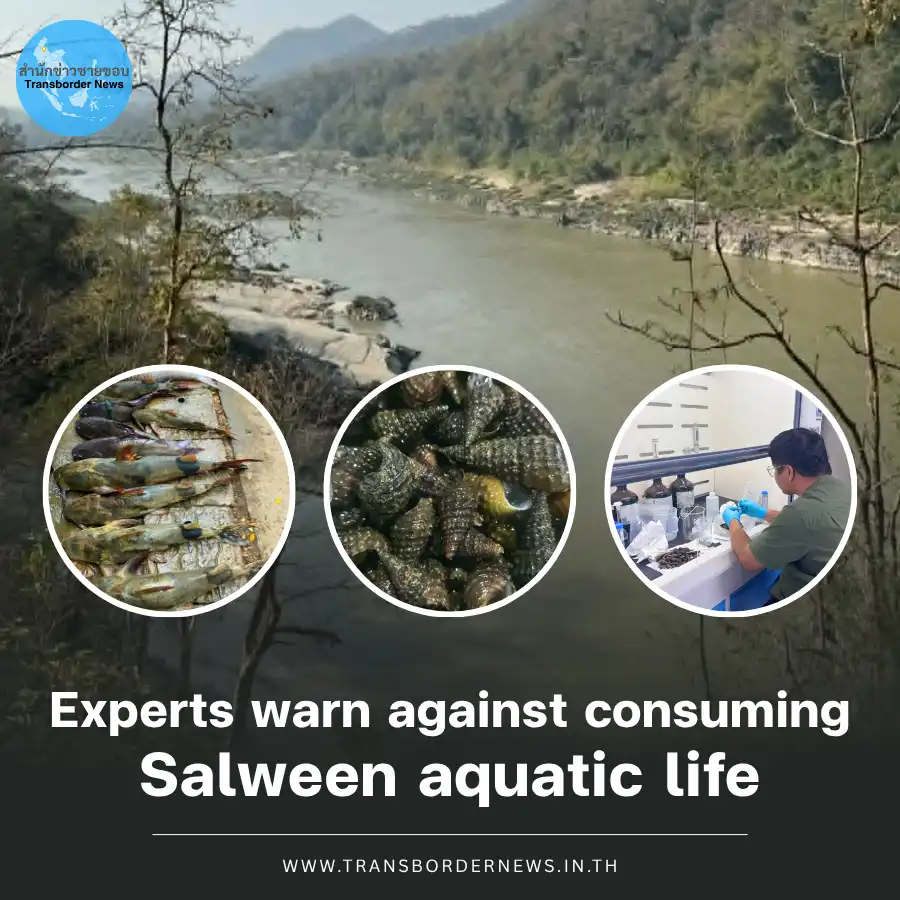
MAE HONG SON — Experts have urged the public to avoid consuming aquatic life from the Salween River after tests found arsenic levels in river snails far exceeding safety standards, raising concerns over wider impacts on ethnic communities along the river.
The warning was issued during an online forum on May 4 organised by transborder News and The Reporters, focusing on toxic contamination in the Salween River and its aquatic species. Speakers included Assistant Professor Dr. Wan Wiriya of Chiang Mai University and Pongpipat Meebenjamas, chief executive of the Mae Sam Laep Subdistrict Administrative Organisation.
The forum followed the release of laboratory results on May 3 showing heavy metal contamination in Salween snails at 10–20 times above safety limits. Earlier tests had also detected arsenic contamination in the river’s water above standard thresholds.
Dr Wan said field sampling of both river snails and water in Sob Moei and Mae Sariang districts confirmed elevated heavy metal levels. He explained that snails, as organisms that accumulate contaminants over time, reflect long-term pollution trends in the ecosystem rather than short-term changes.
“The arsenic we measured was total arsenic, at around 11 milligrams per kilogram,” he said. “However, Thai standards apply to inorganic arsenic, which is more toxic and set at 2 milligrams per kilogram. So we cannot directly compare the figures without further analysis.”
Testing for inorganic arsenic is costly, he added, requiring initial screening followed by confirmatory laboratory tests in Bangkok and Chiang Mai.
Water quality analysis also showed alarming results. Arsenic levels reached 0.099 milligrams per litre — nearly 10 times above the standard of 0.01 mg/L. Data from the Pollution Control Department indicates a rising trend, from about twice the standard last November 2025 to three times in January 2026 and six times in March 2026.
“This shows the contamination is not decreasing but continuing to rise,” Dr Wan said.
He warned that as concentrations increase, so does accumulation in aquatic life. Previous samples of shrimp and fish have also exceeded safety limits. While earlier advice recommended avoiding high-risk parts such as fish heads and internal organs, he said the current situation warrants avoiding consumption of all aquatic species from the Salween for the time being.
Researchers are now coordinating with public health authorities to assess human exposure. “We need to understand consumption patterns — how often people eat these species and for how long — to assess health risks systematically,” he said.
Dr Wan also noted that the Salween is an international river flowing through multiple regions in Myanmar, including Karen, Karenni and Mon states, where large populations depend on the river. “If contamination reaches high levels, the impact will not be limited to Thailand but will affect a much wider region,” he said.
Preliminary data suggests contamination levels in some parts of Myanmar may be even higher than those recorded in Thailand. Researchers are working with trained volunteers across the border to collect additional samples of fish and aquatic species, as well as water from upstream areas, including sections in China.
Mr Pongpipat said the contaminated snail samples were collected from Sob Moei, where tributaries meet the Salween. He noted that snails are a staple food for local communities, particularly during the dry season when water levels are low and clear, making collection easier.
“After receiving the results, we immediately advised villagers to stop consuming snails,” he said. “However, there is concern about long-term accumulation from past consumption, as snails have been widely eaten for many years.”
He added that vulnerable groups — including children, pregnant women, the elderly and those with chronic illnesses — should strictly avoid consumption.
Community concerns have now extended beyond snails to other aquatic species such as fish, shrimp and crabs. Residents have raised questions about whether existing health conditions, including hypertension, numbness in limbs and certain cancers, could be linked to long-term exposure to heavy metals.
“We still cannot answer these questions because there has never been systematic testing,” Mr Pongpipat said. “What we need is health screening to determine whether toxins have accumulated in people’s bodies, so we can develop appropriate prevention and response measures.”
He acknowledged that the problem exceeds the capacity of local authorities, as the source of contamination likely lies outside Thailand’s borders.
“Even with provincial mechanisms involving multiple agencies, most actions are limited to meetings, monitoring and public communication. We cannot address the root cause,” he said.
Efforts by the Pollution Control Department to conduct fieldwork in late April were postponed due to security concerns along the border, following clashes in nearby areas of Myanmar.
“In the meantime, communities can only protect themselves — avoid consumption, reduce risk, and wait for clearer data,” he said.
Pianporn (Pai) Deetes, executive director of Rivers and Rights, said the findings indicate the Salween ecosystem is entering a state of emergency.
“Each round of monitoring shows an increasing trend,” she said. “Satellite analysis by the Stimson Center identified at least 128 mining sites in the Salween basin in Myanmar, with many more small-scale operations likely undetected.”
She added that most of these mines have emerged within the past four to five years, particularly gold and rare earth mines in Shan State, including areas under the influence of the United Wa State Army, among others.
“From the Thai border, the Salween flows downstream to Hpa-an in Karen State and Mawlamyine in Mon State. Communities there are now increasingly concerned after learning about the severe contamination detected in Thailand,” she said.
“There is still no effective system to manage transboundary pollution — from controlling the source, to risk prevention, to ecosystem restoration.”
She also noted a significant rise in mineral imports through border checkpoints along the Salween and Mekong basins in northern Thailand over the past two years, underscoring the growing scale of extractive activity in the region.
The findings highlight mounting concerns over the impact of transboundary pollution on river-dependent communities, particularly ethnic groups living along the Salween, and the urgent need for coordinated regional action.