
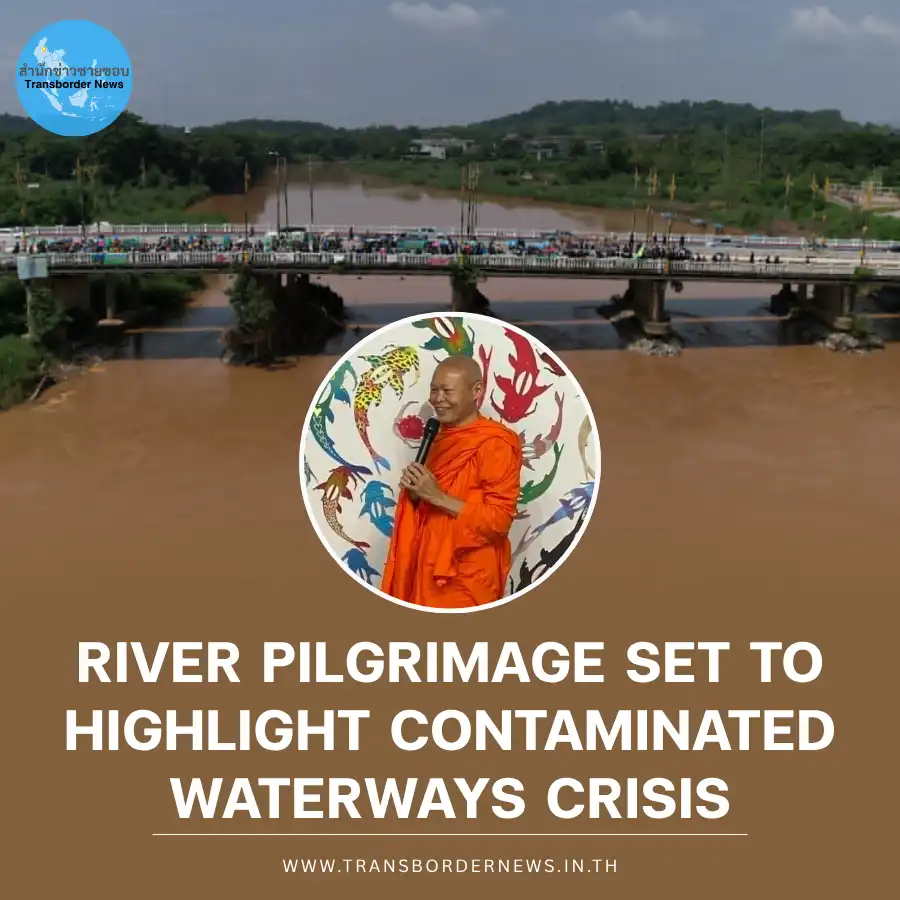
CHIANG MAI — A five-day Buddhist river pilgrimage will be held along the Kok River near Myanmar border from Chiang Mai to Chiang Rai to mark Visakha Bucha Day and World Environment Day, as academics and environmental advocates warn of worsening heavy metal contamination and call for stronger government leadership to address the crisis.
Phra Ajarn Mahanikom Mahaphinikhamano, assistant abbot of Wat Tha Ton in Mae Ai district, said the “Dhamma Yatra for the River” will begin on May 31 and conclude on June 5, coinciding with World Environment Day. The event will bring together monks, novices and members of the public to walk along the Kok River from Tha Ton bridge in Chiang Mai to Chiang Rai town.
“The pilgrimage will take five days and four nights. It is both an act of Buddhist devotion and a campaign to protect rivers and natural resources,” he said. Participants will walk an average of 6–8 kilometres per day, with activities culminating at a riverside park in Chiang Rai.
The Kok River, which stretches about 285 kilometres, originates in Myanmar’s Shan State and flows through northern Thailand for around 155 kilometres before joining the Mekong River at Chiang Saen.
Since 2024, communities in Tha Ton have raised concerns over pollution linked to upstream mining activities in Shan State, including gold and rare earth extraction. Thailand’s Pollution Control Department has reported continuous heavy metal contamination — particularly arsenic — exceeding safety standards for more than a year. Sediment samples from the Mekong near the Golden Triangle have shown arsenic levels up to nine times above thresholds considered hazardous to benthic organisms.
Prof Surichai Wun’Gaeo, chairman of the Ecological Alert and Recovery Thailand (EARTH), and Rivers and Rights, warned that the situation risks repeating Japan’s infamous Minamata disease, a mass mercury poisoning incident that emerged in the 1950s.
He said he first learned about Minamata while studying in Japan in 1968, when the issue dominated national headlines. The disease was traced to industrial wastewater discharged into Minamata Bay, contaminating fish consumed by local communities.
“At first, people did not understand what was happening. Cats showed strange behaviour, and later humans began to fall ill,” he said. “It took years of scientific debate to link the illness to mercury contamination through the food chain.”
He described meeting victims whose nervous systems had been severely damaged, leaving many with permanent disabilities. Infants born to mothers who consumed contaminated seafood were among the worst affected, often suffering congenital disorders despite their mothers showing no symptoms.
“Minamata became a major test of scientific ethics and industrial responsibility,” he said. “Japan was experiencing rapid economic growth, but that growth came with environmental and human costs.”
Drawing parallels with northern Thailand, Prof Surichai said environmental health risks are often overlooked until they become severe.
“Many people do not even know where the Kok River is, unlike the Chao Phraya. But communities in Chiang Rai depend on it for water supply,” he said. “The sources of contamination today are even more complex than in Minamata.”
He criticised the Thai government for lacking urgency, saying heavy metal contamination in the Kok, Sai, Ruak and Mekong rivers has persisted for more than a year without a clear policy response.
“The government still treats this as a distant issue, not an urgent one. Leaders seem more focused on other matters, such as fuel prices, rather than addressing the source of pollution,” he said.
He welcomed efforts by some academics to investigate the issue but said authorities have been more concerned with controlling public messaging than confronting the scale of the problem.
“This is not about causing panic. It is about asking how we prepare and respond,” he said. “Many decision-makers still do not share the sense of urgency felt by affected communities.”
Prof Surichai also raised concerns over the expansion of rare earth mining upstream in Myanmar, particularly in areas with limited governance due to ongoing conflict.
“These operations use chemicals with serious environmental impacts. Mining is taking place in areas where regulation is weak or absent,” he said.
He noted that global demand for rare earth minerals has intensified, with international agreements further driving extraction, but warned that environmental safeguards remain inadequate.
“When we compare this to Minamata, the pattern is similar. Governments prioritise economic growth while the health impacts remain unclear or ignored,” he said.
“We already know that arsenic and heavy metals are highly toxic to ecosystems and humans. The question is why we wait until people fall sick before taking decisive action.”
He stressed that addressing the problem requires strong leadership and a proactive approach.
“What we are seeing now is a large-scale environmental challenge, but the response remains limited,” he said. “We need leadership that recognises the seriousness of the situation and acts before it is too late.”
The upcoming river pilgrimage, organisers say, aims not only to raise awareness but also to call for collective responsibility in protecting one of northern Thailand’s key waterways.