
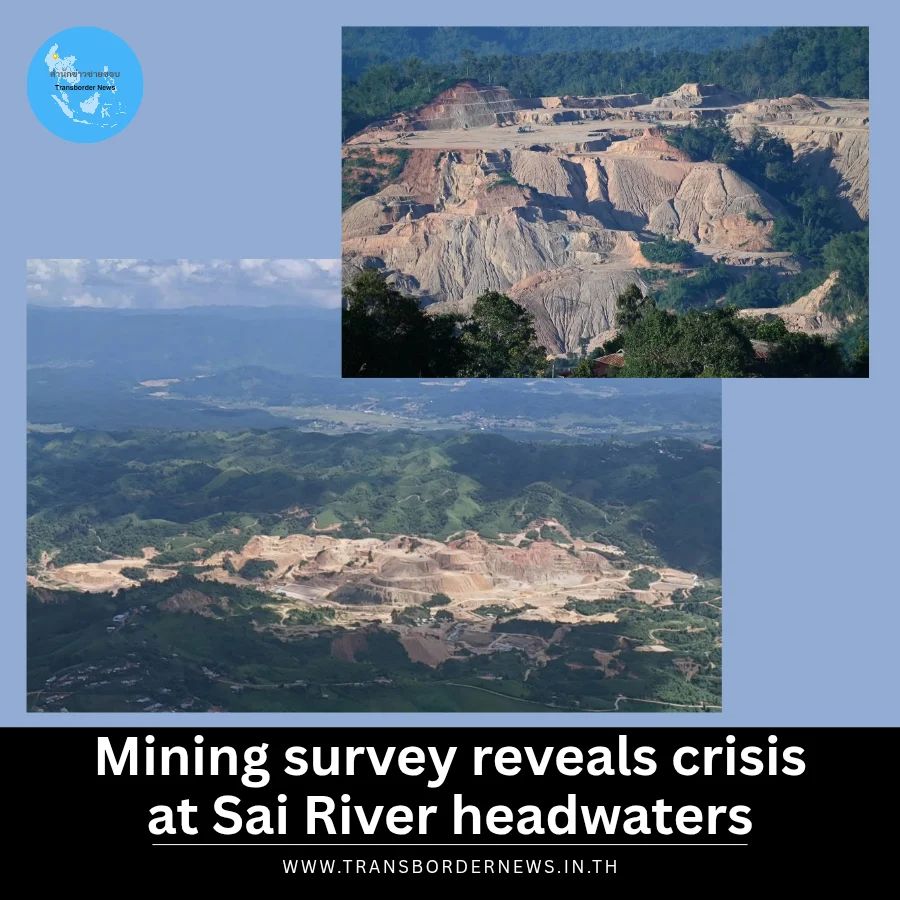
Residents and local sources report rapid expansion of mines in areas controlled by Wa and Myanmar forces, as concerns mount over heavy-metal contamination in the Sai River
CHIANG RAI — Mining operations near the headwaters of the Sai River in Myanmar have expanded rapidly, according to local residents and observations by reporters visiting the Thai-Myanmar border, amid concerns that mining activities could be contributing to heavy-metal contamination detected downstream in Thailand.
On Oct 4, 2026, reporters from Transborder News travelled to the border in Mae Fah Luang district, Chiang Rai, to survey mining activities following a warning by Chiang Rai authorities against using water from the Sai River.
The warning followed tests by Thailand’s Pollution Control Department (PCD) that found arsenic (As) at 0.284 milligrammes per litre — 28.4 times the reference level of 0.01 mg/L — and lead (Pb) at 0.266 mg/L, more than five times the standard.
The reporters first visited the border near Ban Hmong Paet Lang in Thoet Thai subdistrict, Mae Fah Luang district. Across the border lies Mae Jok village in Mong Hsat township, where residents said a large gold mine has operated for the past five to six years.
Local residents claimed the mining operation had been authorised by the Myanmar military and the United Wa State Army (UWSA) and was being carried out by Chinese business interests. The claims could not be independently verified.
Reporters who had previously visited the area said the mine appeared to have expanded rapidly, with earthworks extending across several parts of the mountainside.
They also observed that land clearing had moved close to the Thai border, raising concerns among local residents over whether the activity may have extended into Thai territory. The border in the area has not been clearly demarcated.
One resident said villagers were concerned that the mining could cause soil erosion and affect agricultural land.
Residents said villagers once used a route between Ban Hmong Paet Lang and Mae Jok, but claimed the UWSA and Myanmar military had barred people from the Thai side from crossing into Mae Jok or entering the mining area after mining operations began.
They said Thai villagers had previously crossed the border to cultivate land in the forested area where mining is now taking place.
According to residents, communities on both sides have longstanding family ties, and some Thai villagers formerly cultivated land around Mae Jok because of its fertile soil and higher agricultural yields. Mae Jok Creek, which flows throughout the year, also runs through the area.
Residents said extensive areas of forest and soil had been cleared since mining began and claimed that an old community burial ground had also been encroached upon.
Mae Jok Creek is part of the headwaters feeding the Sai-Ruak river system. Residents said they feared that heavy rainfall could wash sediment from areas cleared for mining into the creek and eventually into the Sai River. No evidence cited in the report establishes that the mines are the source of the arsenic and lead detected downstream.
“The soil over there is very fertile. People farmed there, and whatever they planted grew well. They did not even need fertiliser,” one villager said.
“We used to cross over regularly to visit relatives. There were Hmong, Akha, Lahu and Shan communities. It used to be a small village, but it has grown much larger. We no longer go there because the road is bad and many Wa people have moved in. We cannot communicate with them.”
Residents also claimed that several families in Mae Jok had moved elsewhere after losing access to farmland subsequently used for mining.
They said local land tenure arrangements on the Myanmar side did not always involve formal ownership documents and that villagers traditionally sought permission from village leaders to use land. Residents claimed this allowed mining projects to proceed following approval from local leaders without affected villagers necessarily being informed.
Reporters later travelled to Ban Phaya Phrai in Thoet Thai subdistrict, opposite the Mong Kwan area of Mong Hsat township in eastern Shan State, where another large mining operation could be seen.
Local residents said the Mong Kwan operation began after the Mae Jok mine and had expanded rapidly. They said the site is located in another forested headwater area connected to the Sai River system.
A local source described the area as one in which four armed forces operate in close proximity: the Thai military, the Restoration Council of Shan State/Shan State Army (RCSS/SSA), the United Wa State Army (UWSA) and the Myanmar military.
“The mining area is controlled by the Wa and Myanmar militaries. Ore is transported along routes on their side of the border,” the source said.
The source also claimed Thai authorities were aware of concerns about the impact of mining on the Sai River headwaters and that the Thai military had raised objections several times through the Township Border Committee (TBC), but that the representations had resulted in no apparent change.
These claims could not be independently confirmed with the military authorities concerned.
According to the source, the Mong Kwan mining area has expanded rapidly in recent months, with operations continuing during both the day and night.
The source claimed local residents were prohibited from entering the mine and that security at the site was provided by UWSA and Myanmar military personnel.
Pianporn Deetes, an executive director of Rivers and Rights and , the Hill Area and Community Development Foundation (HADF), said the expansion of mining in the area warranted close attention because of its potential implications for contamination detected in water and river sediments in the Sai and Mekong river systems.
She criticised the Thai government for what she described as insufficient attention to identifying and addressing the sources of the contamination.
“These sources of contamination are right before the eyes of local people and security authorities. Heavy machinery operates 24 hours a day, and people can hear it throughout the night,” Ms Pianporn said.
She said mines were operating close to the Thai border and claimed that more than 850 mining sites with inadequate environmental safeguards were operating across the Mekong basin.
“People in the Sai and Mekong river basins are deeply worried because their rivers are contaminated with toxic substances,” she said. “It is deeply distressing that communities are being left to face this crisis like this.”
.
.
This is a translation of original Thai news report