
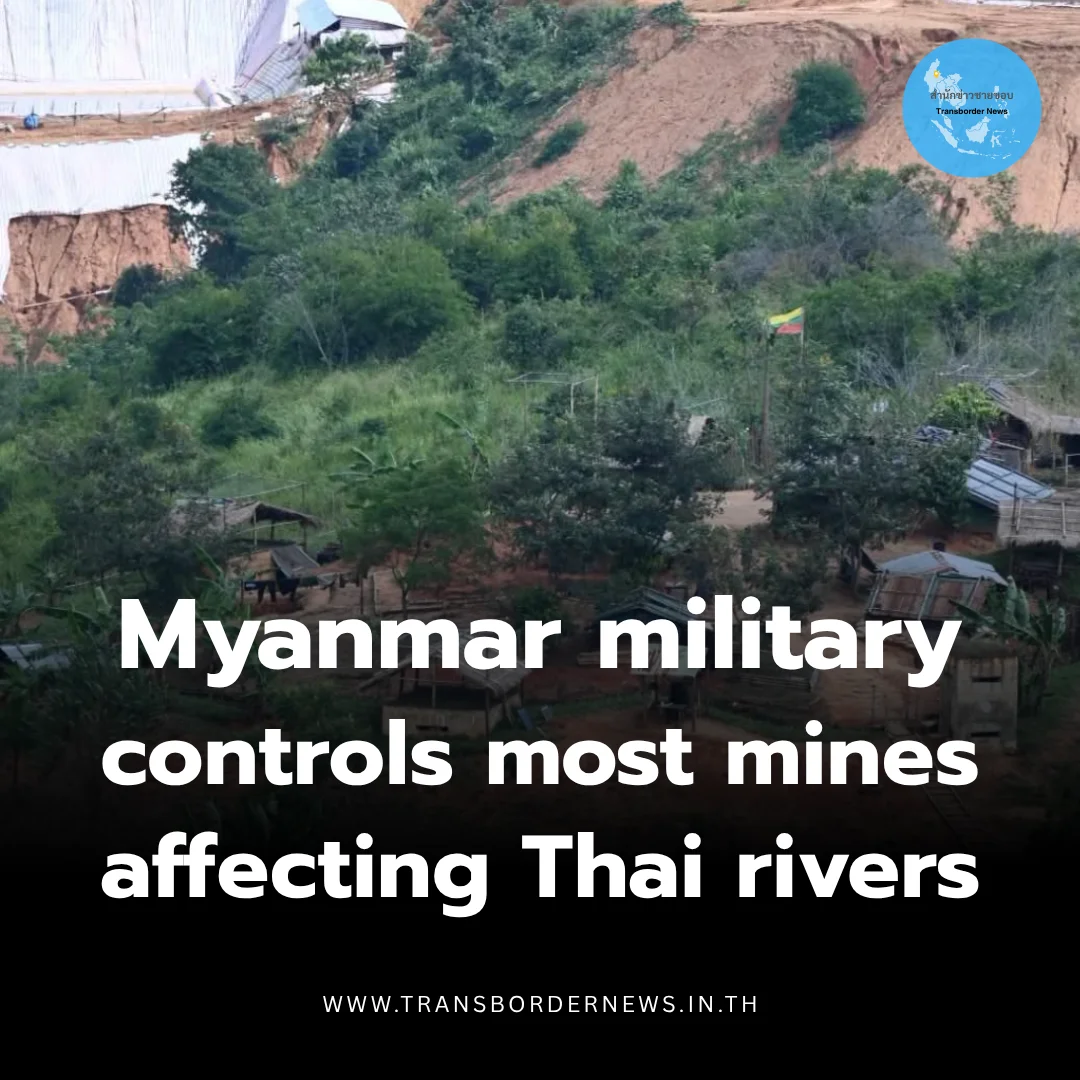
CHIANG RAI: About 60–70% of 33 mines identified as affecting Thailand in the Kok and Sai river basins are controlled by the Myanmar military, according to Thai military sources, with several mining areas expanding by 40–50%.
National Security Council (NSC) secretary-general Gen Chaiyaphruek Duangpraphat led a delegation to Ban Hmong Kao Lang in Thoet Thai subdistrict, Mae Fa Luang district, on Nov 22, 2026, to inspect mining along the border between Thailand and southern Shan State in Myanmar.
A large mine across the border was clearly visible from the Pha Muang Force’s Task Force Chao Tak position at Hmong Kao Lang. A Myanmar military base could also be seen nearby, identifiable by the national flag flying above it. Construction of the mine began in 2024.
Forces stationed across the border include Myanmar troops, Wa and Shan forces, and a Lahu border guard force.
According to sources, Thai troops previously held talks with their Myanmar counterparts about the Mae Jok gold mine, which was operating illegally and releasing chemicals into the environment. Myanmar troops agreed to bring the area under control.
However, Thai military surveys have identified hundreds of mines of varying sizes across the Kok and Sai river basins. Of these, 33 were identified as affecting Thailand. About 60–70% are controlled by the Myanmar military, with the remainder under Wa control.
Military sources said four Wa-controlled gold mines in the Muang Kan area of the Sai River basin, opposite Ban Phaya Phrai, had expanded by 35–45%.
Five gold mines controlled by the Myanmar military had expanded by 40–50%. A new mine, believed to be a tin mine, was also being developed in Myanmar military-controlled territory.
In Muang Tum, two gold mines overseen by the Myanmar military had expanded by 40–50%. Six gold mines in areas under Myanmar military influence in Tachileik had expanded by the same proportion.
Gen Chaiyaphruek said the visit had two purposes. The first was to inspect conditions on the ground and assess the effects on residents.
Although the delegation visited only one site, it offered an example of mining close to the border that was affecting Thailand, he said. Relevant agencies had also briefed him on the broader situation.
The second purpose was to consider measures to prevent and address the problem, including possible sources of negotiating leverage and ways to exert pressure.
He likened the exercise to assessing “what cards we have in our hand”.
Asked whether the site was a newly opened mining area, Gen Chaiyaphruek said it was. The issue also involved the status of the boundary, as the border along the stretch concerned had yet to be demarcated.
Troops operating there had to observe an agreed minimum distance from the boundary, he said. Discussions with local Myanmar military commanders indicated that they understood the arrangement.
Asked whether security agencies would raise mining with Myanmar, Gen Chaiyaphruek said they certainly would, beginning with local-level talks on what the other side should do and where the two sides could cooperate.
Although the boundary had not been demarcated, guidelines already specified what activities were permitted, he said. Nevertheless, gaps had been exploited to carry out activities in the area.
Asked whether this would form part of negotiations, he said it would.
“At the very least, mining should not expand any closer to the border,” he said, adding that the military was closely monitoring the issue and submitting regular reports.
Gen Chaiyaphruek acknowledged that the situation was troubling because the problem had persisted for some time.
A lasting solution would take time, but affected residents could not wait, he said. Immediate action was therefore needed to ease their hardship.
Asked whether the influence of ethnic armed groups would complicate efforts to resolve the problem, he said options remained available, but each group and area would need to be considered separately.
Authorities would have to distinguish between lawful and unlawful operations in areas controlled by the Myanmar government and determine the appropriate measures in each case.
For areas under the influence of groups outside government control, they would need to identify suitable channels and approaches, he said.
The delegation later met Chiang Rai civil society representatives at Chan Ka Phak restaurant. Participants included Tuenjai Deetes, founder of the Hill Area and Community Development Foundation, and Arisara Lekkham, an international law lecturer at Mae Fah Luang University’s School of Law.
Civil society representatives said mining had displaced people living near the sites, prompting some to cross into Thailand.
They also raised concerns about mining in the Mekong riverbed, saying the issue should be taken up with authorities in Laos.
This is a translation of original Thai news article. https://transbordernews.in.th/home/?p=48477