
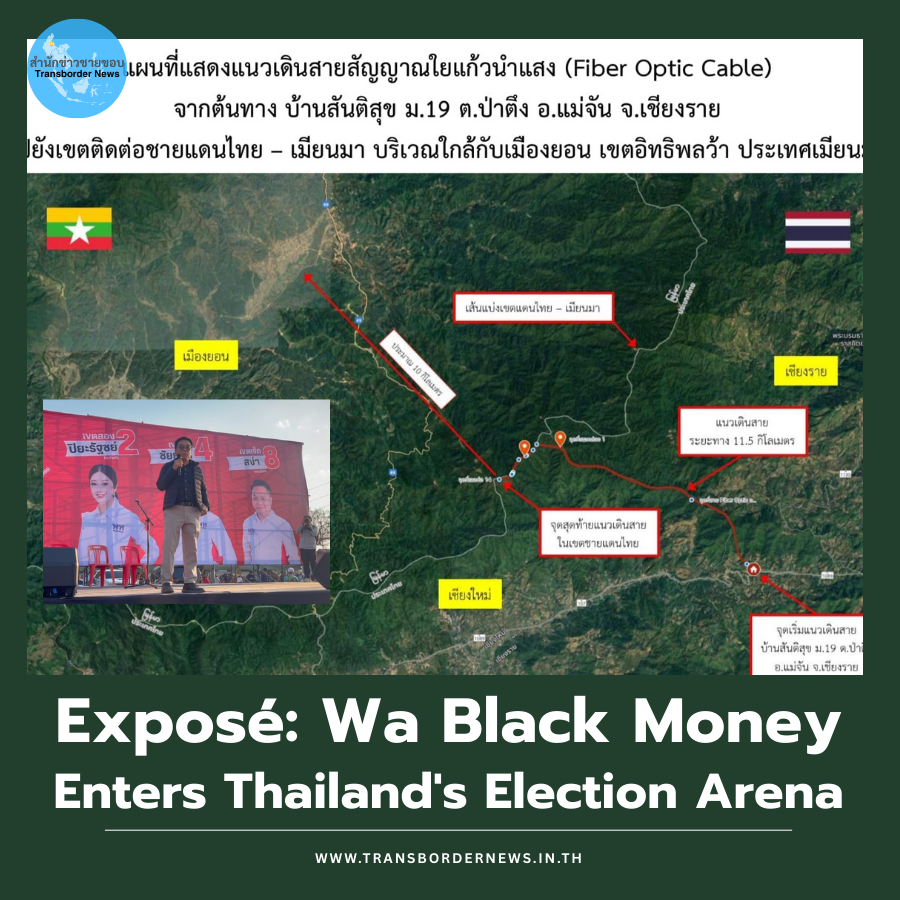
Former House speaker and natural resources minister Yongyuth Tiyapairat has alleged that the United Wa State Army (UWSA), also known in Thai as the “Red Wa,” is using proceeds from drug trafficking to purchase political influence in Thailand, including intervening in elections, intimidating villagers, and illegally acquiring Thai citizenship through coercion.
Speaking on Jan 30 at a campaign rally in support of Piyarat Tiyapairat, a Pheu Thai Party candidate for Chiang Rai’s Constituency 2, in Mae Chan district, Chiang Rai, Mr Yongyuth said Wa operatives had previously produced and sold methamphetamine near Pa Tung subdistrict. The area, he said, is now heavily militarised, with heavy weapons and mortars present.
He said that Thai soldiers who inspected the area discovered underground piping leading into territory controlled by the UWSA. When dismantled, the pipes were found to contain telephone and electricity cables, allegedly used to facilitate scams.
“When officials moved to make arrests, the case stalled in Bangkok. No one knows why,” Mr Yongyuth said. “The Wa buy some local administrative officials, some village headmen, and recruit their subordinates. They then deceive villagers and our children.”
He cited a recent case in Ban Thung Tang where a mother contacted him in tears after her 17-year-old son was arrested in Pa Tung and taken by the Crime Suppression Division to Bangkok, allegedly for involvement in opening mule bank accounts. Mr Yongyuth played an audio recording of a resident describing how a relative was arrested after staying overnight at a friend’s house.
Mr Yongyuth further alleged that the Wa are forcibly obtaining Thai ID cards from Lahu villagers who have long held Thai nationality.
“Getting a Thai ID card is difficult. The Wa migrated from southern China and settled around Pa Tung. They threaten Lahu villagers at gunpoint, demand their ID cards, and offer money. They ask: do you want to die or take the money?” he said. “They then drive the villagers out and assume their identities. That’s how they become ‘Thai’ and expand their influence.”
He also accused corrupt police officers of siding with Wa interests and discouraging people from voting for Pheu Thai, claiming the party only talks about old policies such as the 30-baht universal healthcare scheme.
“Yes, it’s an old policy,” Mr Yongyuth said. “But it is an old policy that has benefited the people.”
The former House speaker said Wa-linked money had bought over some community leaders and former Pheu Thai figures.
“They used to love Pheu Thai, but once Wa money appeared, they all went silent. People remember they once followed Thaksin Shinawatra. Today they follow the Wa. They say Pheu Thai can’t compete with Wa money,” he said.
He urged voters to reject handouts linked to what he called “grey parties” and “drug money”, warning that such funds came from narcotics trafficking and ties with the Wa.
In July 2024, security agencies seized a 10.5-kilometre underground fibre-optic cable running across the Thai-Myanmar border, used to transmit internet signals. The cable originated in Ban Santisuk, Village 19, Pa Tung subdistrict, Mae Chan district, and extended to a Wa military base in Mong Yawn, Myanmar.
However, the case has since gone quiet amid allegations that Wa groups bribed certain officials, resulting in no further progress. Most recently, Wa-linked groups are reported to have fielded representatives as candidates in elections at multiple levels.
This is a translation of original Thai article https://transbordernews.in.th/home/?p=45054
transbordernews.in.th