
CHIANG RAI: Arsenic has been detected in the bodies of residents living along the Kok River, raising concerns of long-term health impacts if the situation is left unaddressed, academics said at a policy dialogue on Tuesday.
The findings were presented on February 24, 2026 at a meeting in Chiang Rai, aimed at developing community-driven policy proposals in response to toxic contamination in the Kok River. Researchers from Mae Fah Luang University (MFU) reported arsenic accumulation in human samples collected from four locations: Ban Tha Ton in Chiang Mai’s Mae Ai district, and three sites in Chiang Rai — Doi Hang (Mae Yao), Dong Mahawan (Wiang Chiang Rung), and Ban Saeo (Chiang Saen).
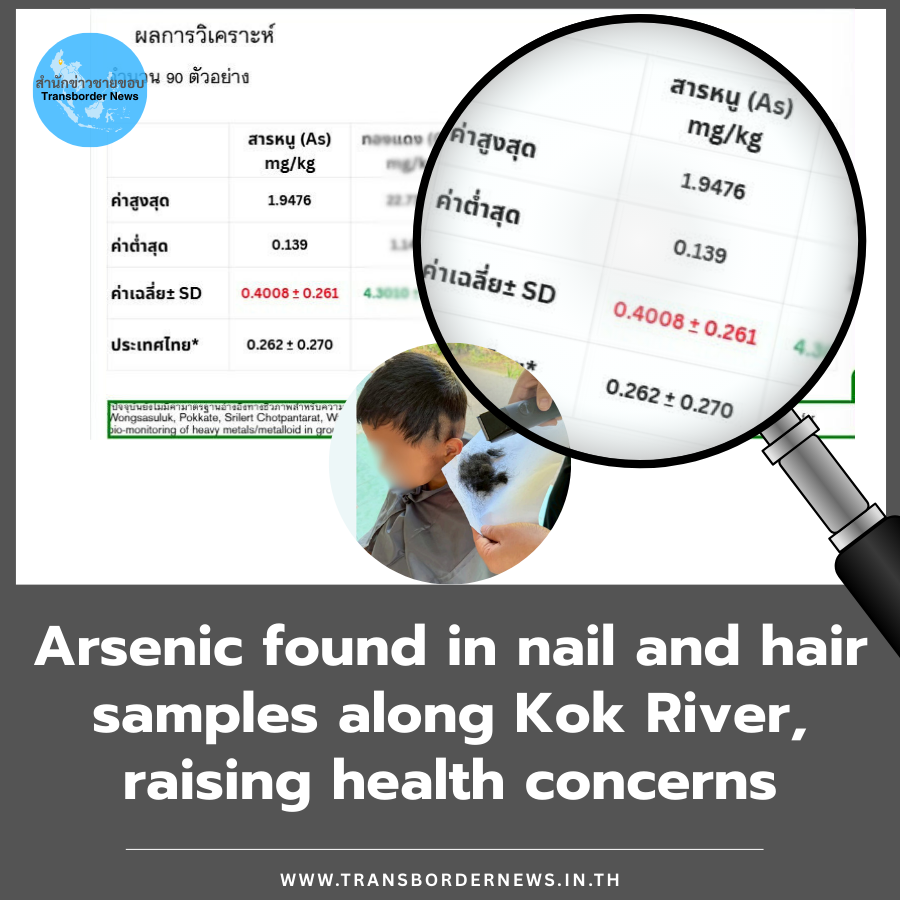
Dr Siriwan Kantisin, a lecturer in occupational health and safety at MFU’s School of Health Science, said arsenic was found in fingernail samples from adults and hair samples from children in all surveyed areas, indicating exposure and accumulation in the body.
According to data presented at the meeting, 16 out of 90 samples — or 17.78% — showed arsenic levels in fingernails exceeding the standard threshold of 0.5 mg/kg. Among those with elevated levels, clinical symptoms were observed, including numbness and muscle weakness in the extremities (62.5%), skin irritation (43.8%), abnormal skin pigmentation or thickened lesions resembling corns (31.1%), respiratory issues such as nasal inflammation and septal perforation (18.8%), as well as swelling of both feet (18.8%) and reduced urine output (12.5%).
Assoc Prof Satien Chanta of Chiang Rai Rajabhat University said the presence of arsenic in nails and hair indicates that the body is unable to fully eliminate the toxin, signalling ongoing accumulation. However, Thailand currently lacks clear benchmarks for what constitutes dangerous levels of arsenic in the human body, he said, suggesting that international standards, such as those of the World Health Organization, may need to be referenced.
“This research should help drive policy. The key question is how the government will respond to at-risk populations,” he said. “Authorities must urgently conduct further testing, confirm the findings, and develop concrete measures to manage the health risks.”
He added that the Public Health Ministry and the Interior Ministry must work in an integrated manner, stressing that the issue is urgent as previous testing by the Department of Disease Control had already found arsenic in the urine of riverside residents.
Assoc Prof Satien also called on the government to consolidate available data and communicate risks clearly to affected communities, noting that most residents are unlikely to relocate and must instead be equipped with the knowledge to live safely under current conditions.
Over the past year, he said, public awareness of heavy metal contamination in the Kok, Sai, Ruak and Mekong rivers has outpaced government action. “State agencies face limitations in addressing the issue. At the local level, we have yet to see concrete measures in agriculture, tourism or fisheries, while at the national level there is still no dedicated task force translating field data into policy and practice,” he said.
He also noted a lack of progress in both bilateral and multilateral efforts to address transboundary pollution (from mining in Myanmar). While Thailand and Myanmar have agreed to conduct joint water testing, differences in arsenic standards remain unresolved. No significant advancement has been seen in regional frameworks such as the Mekong River Commission or Lancang-Mekong Cooperation mechanism, he added.
Somporn Pengkham, director of the Health Impact Assessment Platform, said the findings — particularly arsenic levels in nails exceeding standard thresholds — indicate early stages of accumulation that could lead to increased cases of arsenic poisoning if exposure is not reduced.
She identified water and food — especially rice grown in contaminated irrigation systems — as the primary pathways through which arsenic enters the human body.
To strengthen prevention, she proposed designating arsenic poisoning as a “notifiable disease under surveillance” under the Occupational and Environmental Disease Act, enabling local authorities and communities to establish monitoring systems, tailor preventive measures to specific risks, and ensure timely reporting and treatment of suspected cases.
She also called for capacity building among village water supply committees to improve understanding of arsenic and heavy metal treatment systems, including field testing of raw and treated water, sample collection, and interpretation of laboratory results. Under Thailand’s Public Health Act, local administrative organisations are responsible for managing community water systems.
“Environmental health literacy must be urgently strengthened among local officials, health service providers and communities,” she said, adding that communities should be supported with tools and technology to conduct preliminary risk assessments, collect samples and access timely screening and healthcare services.
Dr.Suebsakun Kitnukorn, an academic at MFU, raised concerns over recent statements by the Pollution Control Department (PCD) claiming that toxin levels in the Kok River were within safe limits.
He pointed to inconsistencies in testing practices, noting that the PCD typically advises that field test kits must be used alongside laboratory analysis, yet recent public statements appeared to rely solely on test kit results.
He also questioned the limited number of sampling sites and whether other rivers — including the Sai, Ruak and Mekong — had been adequately tested. Previous PCD monitoring conducted between Jan 13–16 had already found arsenic levels exceeding standards at key locations along the Kok River, including Tha Ton Bridge and Mae Na Wang Bridge, he said.
Dr.Suebsakun further criticised public guidance that encouraged recreational water activities, warning that such actions could stir up contaminated sediment and increase exposure risks. Conflicting advice on fish consumption — such as avoiding fish heads or liver — has also added to public confusion, he said.
He called for a formal multi-stakeholder consultation involving the PCD, Chiang Rai authorities, academics, civil society and business operators to develop a coordinated response.
“We need a joint decision-making process to find a way forward,” he said.
—-
This is a translation of original Thai news article https://transbordernews.in.th/home/?p=45220
transbordernews.in.th