
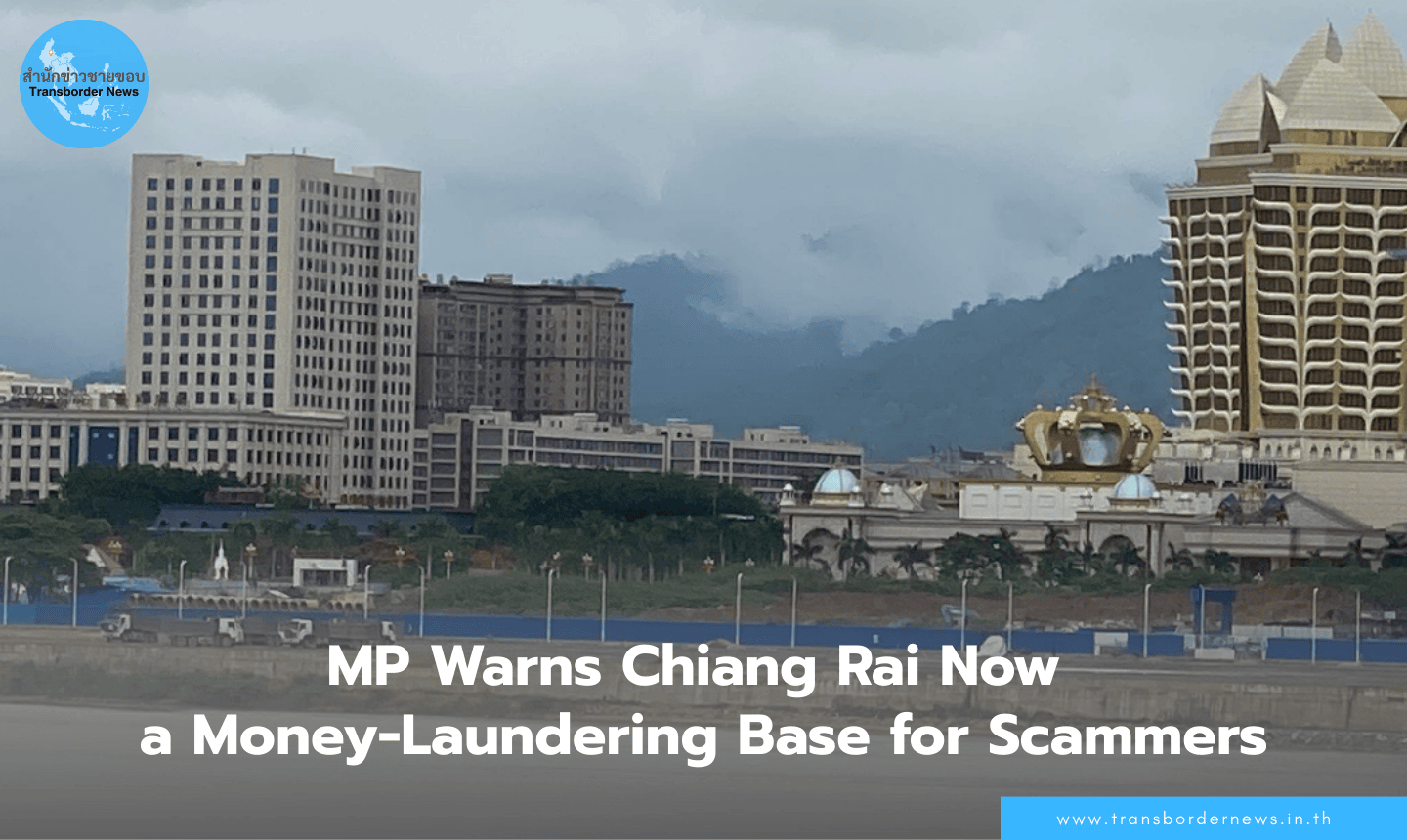
CHIANG RAI — On December 3, the House of Representatives’ Police Committee held a seminar titled “Understanding Cyber Risks: Preventing Victims Before They Fall” in Muang district, Chiang Rai. Speakers included Wiroj Lakkhanaadisorn, party-list MP of the People’s Party; Thakorn Yasang, Chiang Rai MP and vice-chair of the committee; along with senior police officers, prosecutors, and the provincial commerce office. Around 300 participants — police, teachers, students, and education personnel — attended.
Wiroj said the rising number of youths deceived into opening “mule accounts” was deeply worrying, and called for a coordinated community effort to stop this trend. Local administrators, teachers, village heads, community leaders, and parent networks must step up surveillance — especially in “skip-generation” households where children live with grandparents while parents work elsewhere. If a child is approached by strangers — or even acquaintances — to open a mule account, adults must intervene immediately.
Turning to cross-border crime, Wiroj said Chiang Rai is now heavily influenced by online scam syndicates operating from Myanmar, Cambodia and Laos. Illicit funds flowing in from Laos alone are estimated at 390 billion baht annually. These scams often use computer-generated outcomes to convince victims they are winning, before wiping out their funds entirely.
He warned that laundered money is now being pumped back into Chiang Rai through cash purchases of hotels, resorts, pubs, bars, restaurants, retail shops, transport companies, car washes and even cafés — as well as through participation in government procurement, such as school lunch programmes.
“These dirty funds distort the market,” Wiroj said. “Honest entrepreneurs cannot compete when grey capital is willing to undercut prices or operate at a loss. Local businesses collapse, the economy stagnates, workers lose jobs, and many are pushed into the mule-account or nominee system.”
He emphasised the crucial role of the private sector — including business associations, chambers of commerce and the Federation of Thai Industries — in identifying suspicious newcomers. “Locals know their business landscape well. If a new operator appears with no clear background and engages in predatory pricing, they should alert the Provincial Commerce Office to check the shareholder structure and potential nominee arrangements.”
According to Wiroj, companies involved in money laundering typically channel transactions through a single law firm, using the same nominee groups who cross-hold shares in 20–30 companies. These patterns, he said, can be easily detected by the provincial commerce office or the Department of Business Development.
He also urged the Chiang Rai Revenue Department to investigate these entities. “Do not focus only on honest taxpayers. Money-laundering businesses often falsify accounts, inflate revenues, or operate ‘zero-dollar tour’ models to evade tax. With cooperation from local business groups, authorities can identify clear targets. If a predicate offence is found, the Anti-Money Laundering Office (AMLO) must trace financial flows and seize assets. I am pushing the Revenue Department to take this seriously.”
Wiroj warned that Thailand risks being grey-listed by FATF if it continues to tolerate criminal infiltration. “If we let criminals embed themselves here, we could be blacklisted as a grey economy. Foreign direct investment will decline, supply chains cannot grow, high-skill employment will stall, and the country’s financial stability will weaken. Market manipulation, public-sector bribery and tax evasion will erode the economy further.”
He cited estimates of illicit flows from the scam industry: around 330 billion baht circulating in Laos, 390 billion in Cambodia, and approximately 550 billion in Myanmar — totalling 1.4 trillion baht annually, involving more than 300,000 workers across the three countries. “American victims lose about US$10 billion a year, roughly 300 billion baht. Thailand’s losses are 115.3 billion baht — but relative to GDP, our damage is more than five times worse.”
This is a translation of original Thai news article https://transbordernews.in.th/home/?p=44620